Chapter 1Something is seriously wrong. It has to do with our ATTENTION, our essential ability to give our minds and senses to the world. This precious capacity has been channeled, captured, and commodified by an industry of immense technological and financial power. How? Call it “human fracking.”
Human fracking is bad for people, and for politics. It reduces our very beings (and our relationships) to that which can be quantified, bought, and sold. All this is the triumph of a catastrophic lie about what it means to be human. But deceit and exploitation are never inevitable. To push back, we need more than isolated, individual efforts; what we need is a movement of collective resistance.
This movement of attentional liberation exists and has a name: ATTENTION ACTIVISM.
Attention Activism is a fight for justice. This emancipatory uprising takes our apocalyptic present, turns it on its head, and creates, from the chaos and confusion, new vistas of human flourishing.
Attention Activism is rooted in STUDY—a commitment to diverse forms of teaching and learning centered on attention (what it is, what it can be, what it can do). Attention Activism also requires COALITION-BULIDING—collaboration and solidarity across a range of communities who see attention’s essential role in human flourishing. Finally, Attention Activism means the formation of SANCTUARIES—spaces where people can gather, care for each other, experiment with different kinds of attention, and conceive brighter futures.
To discern the revolutionary possibilities of the present, we look to artists, thinkers, and dreamers. To bring those possibilities to bloom, we heed the countless Attention Activists who are already out there, devising new (and revising old) ways of giving their minds and senses to each other and the world.
These attentionauts and attentionistas draw on the wisdom of diverse traditions. Across uncharted terrain, emerging practices of joint attention illuminate new horizons of shared political power. Not only power, but beauty, and grace, too.
This is our movement: the free movement of attention in its fullness, freely shared. We call that transformative goodness ATTENSITY. Join us in this heightened and heightening glory—or let us join you!
You are correct: Something is seriously wrong.
We are living in conditions contrary to basic wellness.
We feel it, too. We, too, are lonely, plagued by anomie, troubled by the sense of a fundamental disconnection between ourselves and what’s real. The world seems to have slanted sideways. The more we try to be in contact with the people and things that promise to sustain us, the more isolated we become.
But how could it be otherwise? It makes perfect sense that we do not know how to live when our actual people (our friends, coworkers, lovers, even family) increasingly come to us as pop-up snapshots served between advertisements; when our access to the world is determined by our consumer preference categories; when extractive digital networks shape every aspect of daily life; when we do CAPTCHA tests to prove our humanity. We do not know how to live when we are continuously needled by our feeds into anguish and outrage in relation to distant events and lives over which we have no control.
And yet we’re tired of watching our friends and family (and ourselves) fail to flourish under these conditions. We tire of seeing our people diagnosed with mental disorders—as though failing to flourish in inhuman conditions is some individual quirk, maladjustment, or malady.
It is all so obvious that it scarcely bears elaboration: We are living under conditions that are contrary to basic wellness—of ourselves, our communities, and our planet.
We, too, awaken our screens in the morning, and are accosted by headlines announcing epidemics of depression and alienation, the collapse of our most trusted institutions, and the breakdown of our planet’s basic ecological cycles. These harms are numerous and diverse, but they are characterized by a common trend toward dissociation, toward severing and solitude.
Consider: Over the past ten years, suicide attempts and feelings of persistent hopelessness among high school students have increased by a staggering 40 percent. Girls are at greater risk—one in ten American female teens actually attempted self-destruction in 2024, and studies suggest that nearly a third experienced suicidal ideation. Never before have young people found themselves to be so disconnected from the things that make life worthwhile. We are confronting a pandemic of loneliness, and an unprecedented spike in “deaths of despair.”
We see comparable changes in a political landscape ravaged by social rupture and polarization. Instead of the messy-but-hopeful “enactment of democracy,” we find ourselves discharging open sewers of contempt into the ever-widening gulf between one virtual silo and another—disintegrating our ability to recognize our common condition, achieve consensus amid conflict, and thereby overcome existential threats.
And the threats are existential. The steady advance of climate catastrophe has pitched forward into a full-frontal assault. We are, more than ever, undeniably enmeshed with the worlds of water and air and soil. Yet even as the urgency of our ecological condition batters our spirits with each wildfire, hurricane, or deranging balmy December day, we wonder if, perhaps, this is not so abnormal after all. If our bodily senses return us only to a state of mounting dread, can they be trusted?
What we love most is at stake. It’s enough to get anyone out of the chair and into the street!
But among the catastrophes of our present moment is that the very means by which these disasters are brought to our awareness—twenty-four-hour news, the ping of cascading notifications, the endless scroll—act not as a bridge into the world, but as the actual mechanisms of further isolation and distance. The more urgent our collective problems become, the less real they seem to be.
How is this possible?
How have we been separated from each other and the world—and even from ourselves—at the absolute historical apex of global communicative interconnection?
The answer, we believe, is surprisingly simple: The actual stuff of all connection—the true way we are present to being, beings, and everything else—is neither a network nor a device. It isn’t outrage, or, for that matter, hope. It isn’t blood, sweat, or tears, either. It is attention.
And they have seriously f***ed with our attention.
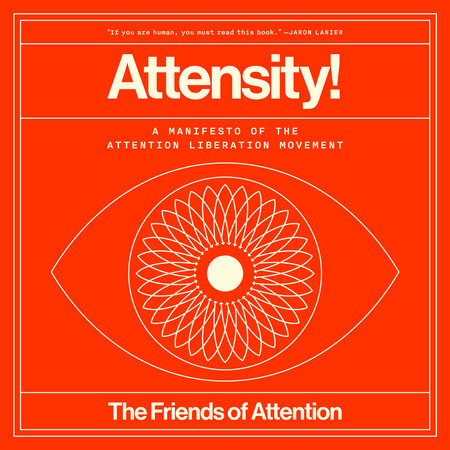
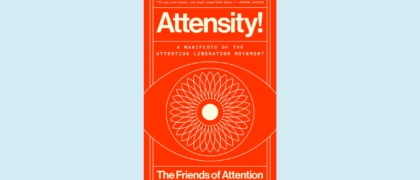
ATTENSITY!
A Manifesto of the Attention Liberation Movement
You are correct: Something is seriously wrong. It has to do with our ATTENTION, our essential ability to give our minds and senses to the world. This precious capacity has been channeled, captured, and commodified by an industry of immense technological and financial power. How? Call it “human fracking.”
Human fracking is bad for people, and for politics. It reduces our very beings (and our relationships) to that which can be quantified, bought, and sold. All this is the triumph of a catastrophic lie about what it means to be human. But deceit and exploitation are never inevitable. To push back, we need more than isolated, individual efforts; what we need is a movement of collective resistance.
This movement of attentional liberation exists and has a name: ATTENTION ACTIVISM.
Attention Activism is a fight for justice. This emancipatory uprising takes our apocalyptic present, turns it on its head, and creates, from the chaos and confusion, new vistas of human flourishing.
Attention Activism is rooted in STUDY—a commitment to diverse forms of teaching and learning centered on attention (what it is, what it can be, what it can do). Attention Activism also requires COALITION-BUILDING—collaboration and solidarity across a range of communities who see attention’s essential role in human flourishing. Finally, Attention Activism means the formation of SANCTUARIES—spaces where people can gather, care for each other, experiment with different kinds of attention, and conceive brighter futures.
To discern the revolutionary possibilities of the present, we look to artists, thinkers, and dreamers. To bring those possibilities to bloom, we heed the countless Attention Activists who are already out there, devising new (and revising old) ways of giving their minds and senses to each other and the world.
These attentionauts and attentionistas draw on the wisdom of diverse traditions. Across uncharted terrain, emerging practices of joint attention illuminate new horizons of shared political power. Not only power, but beauty, and grace, too.
This is our movement: the free movement of attention in its fullness, freely shared. We call that transformative goodness ATTENSITY. Join us in this heightened and heightening glory—or let us join you!
It has to do with our attention, our essential ability to give our minds and senses to the world.
In efforts to define attention, some emphasize its relationship to catalyzing action, while others emphasize its endless receptivity. We resolve the tension between these two definitions by offering a third.
What is attention? The experts do not agree. In fact, they actively contradict each other.
Copyright © 2026 by The Friends of Attention. All rights reserved. No part of this excerpt may be reproduced or reprinted without permission in writing from the publisher.