Download high-resolution image Look inside
Listen to a clip from the audiobook
audio pause button
0:00
0:00

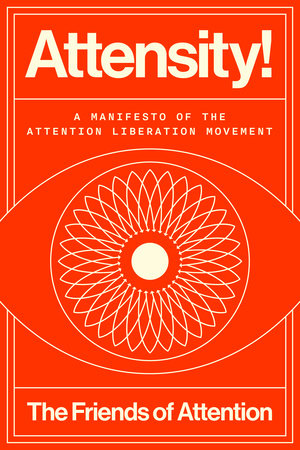
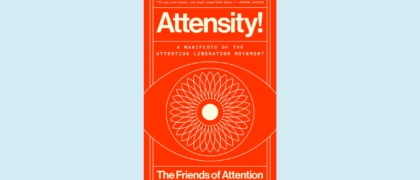
Attensity!

A Manifesto of the Attention Liberation Movement

Look inside
Listen to a clip from the audiobook
audio pause button
0:00
0:00
A rallying cry to fight the commodification of human attention, with the tools we need to reclaim our humanity, by a group of writers, artists, and activists in the vanguard of the movement

“A stirring battle cry on behalf of our shared humanity against the forces that seek to diminish and degrade it. Downright invigorating. Just what the moment calls for.”—Chris Hayes, author of The Sirens’ Call


We all feel it: something is seriously wrong. Our attention—that essential ability to give our minds and senses to the world—is being trapped, gutted, and sold out from under us by an industry of immense technological and financial power. The heedless exploitation of this vital capacity by a handful of tech companies is harming us all, reducing our very selfhood to that which can be quantified, bought, and sold—and shaking the foundations of our democracy.

To push back against this “human fracking,” we need more than individual willpower or isolated efforts. We need a movement of collective resistance. Such a movement is beginning to bloom, and in this radical, first-of-its-kind guide, The Friends of Attention show us how to join the fight. We meet welders, nurses, poets, and surfers, all of whom are engaged in attentional practices. We learn to seek out sanctuaries—theaters and museums, houses of worship, dance parties—where together we can take refuge from the frackers. Attention Activism takes our apocalyptic present, turns it on its head, and reveals new vistas of human flourishing.

Drawing on a rich legacy of critical intellectuals and the creative wisdom of diverse traditions, Attensity! calls on us to come together to defeat the greedy dehumanizing forces of brute instrumentalization—and re-enchant the world.
Chapter 1

Something is seriously wrong. It has to do with our ATTENTION, our essential ability to give our minds and senses to the world. This precious capacity has been channeled, captured, and commodified by an industry of immense technological and financial power. How? Call it “human fracking.”

Human fracking is bad for people, and for politics. It reduces our very beings (and our relationships) to that which can be quantified, bought, and sold. All this is the triumph of a catastrophic lie about what it means to be human. But deceit and exploitation are never inevitable. To push back, we need more than isolated, individual efforts; what we need is a movement of collective resistance.

This movement of attentional liberation exists and has a name: ATTENTION ACTIVISM.

Attention Activism is a fight for justice. This emancipatory uprising takes our apocalyptic present, turns it on its head, and creates, from the chaos and confusion, new vistas of human flourishing.

Attention Activism is rooted in STUDY—a commitment to diverse forms of teaching and learning centered on attention (what it is, what it can be, what it can do). Attention Activism also requires COALITION-BULIDING—collaboration and solidarity across a range of communities who see attention’s essential role in human flourishing. Finally, Attention Activism means the formation of SANCTUARIES—spaces where people can gather, care for each other, experiment with different kinds of attention, and conceive brighter futures.

To discern the revolutionary possibilities of the present, we look to artists, thinkers, and dreamers. To bring those possibilities to bloom, we heed the countless Attention Activists who are already out there, devising new (and revising old) ways of giving their minds and senses to each other and the world.

These attentionauts and attentionistas draw on the wisdom of diverse traditions. Across uncharted terrain, emerging practices of joint attention illuminate new horizons of shared political power. Not only power, but beauty, and grace, too.

This is our movement: the free movement of attention in its fullness, freely shared. We call that transformative goodness ATTENSITY. Join us in this heightened and heightening glory—or let us join you!

You are correct: Something is seriously wrong.

We are living in conditions contrary to basic wellness.

We feel it, too. We, too, are lonely, plagued by anomie, troubled by the sense of a fundamental disconnection between ourselves and what’s real. The world seems to have slanted sideways. The more we try to be in contact with the people and things that promise to sustain us, the more isolated we become.

But how could it be otherwise? It makes perfect sense that we do not know how to live when our actual people (our friends, coworkers, lovers, even family) increasingly come to us as pop-up snapshots served between advertisements; when our access to the world is determined by our consumer preference categories; when extractive digital networks shape every aspect of daily life; when we do CAPTCHA tests to prove our humanity. We do not know how to live when we are continuously needled by our feeds into anguish and outrage in relation to distant events and lives over which we have no control.

And yet we’re tired of watching our friends and family (and ourselves) fail to flourish under these conditions. We tire of seeing our people diagnosed with mental disorders—as though failing to flourish in inhuman conditions is some individual quirk, maladjustment, or malady.

It is all so obvious that it scarcely bears elaboration: We are living under conditions that are contrary to basic wellness—of ourselves, our communities, and our planet.

We, too, awaken our screens in the morning, and are accosted by headlines announcing epidemics of depression and alienation, the collapse of our most trusted institutions, and the breakdown of our planet’s basic ecological cycles. These harms are numerous and diverse, but they are characterized by a common trend toward dissociation, toward severing and solitude.

Consider: Over the past ten years, suicide attempts and feelings of persistent hopelessness among high school students have increased by a staggering 40 percent. Girls are at greater risk—one in ten American female teens actually attempted self-destruction in 2024, and studies suggest that nearly a third experienced suicidal ideation. Never before have young people found themselves to be so disconnected from the things that make life worthwhile. We are confronting a pandemic of loneliness, and an unprecedented spike in “deaths of despair.”

We see comparable changes in a political landscape ravaged by social rupture and polarization. Instead of the messy-but-hopeful “enactment of democracy,” we find ourselves discharging open sewers of contempt into the ever-widening gulf between one virtual silo and another—disintegrating our ability to recognize our common condition, achieve consensus amid conflict, and thereby overcome existential threats.

And the threats are existential. The steady advance of climate catastrophe has pitched forward into a full-frontal assault. We are, more than ever, undeniably enmeshed with the worlds of water and air and soil. Yet even as the urgency of our ecological condition batters our spirits with each wildfire, hurricane, or deranging balmy December day, we wonder if, perhaps, this is not so abnormal after all. If our bodily senses return us only to a state of mounting dread, can they be trusted?

What we love most is at stake. It’s enough to get anyone out of the chair and into the street!

But among the catastrophes of our present moment is that the very means by which these disasters are brought to our awareness—twenty-four-hour news, the ping of cascading notifications, the endless scroll—act not as a bridge into the world, but as the actual mechanisms of further isolation and distance. The more urgent our collective problems become, the less real they seem to be.

How is this possible?

How have we been separated from each other and the world—and even from ourselves—at the absolute historical apex of global communicative interconnection?

The answer, we believe, is surprisingly simple: The actual stuff of all connection—the true way we are present to being, beings, and everything else—is neither a network nor a device. It isn’t outrage, or, for that matter, hope. It isn’t blood, sweat, or tears, either. It is attention.

And they have seriously f***ed with our attention.

ATTENSITY!

A Manifesto of the Attention Liberation Movement

You are correct: Something is seriously wrong. It has to do with our ATTENTION, our essential ability to give our minds and senses to the world. This precious capacity has been channeled, captured, and commodified by an industry of immense technological and financial power. How? Call it “human fracking.”

Human fracking is bad for people, and for politics. It reduces our very beings (and our relationships) to that which can be quantified, bought, and sold. All this is the triumph of a catastrophic lie about what it means to be human. But deceit and exploitation are never inevitable. To push back, we need more than isolated, individual efforts; what we need is a movement of collective resistance.

This movement of attentional liberation exists and has a name: ATTENTION ACTIVISM.

Attention Activism is a fight for justice. This emancipatory uprising takes our apocalyptic present, turns it on its head, and creates, from the chaos and confusion, new vistas of human flourishing.

Attention Activism is rooted in STUDY—a commitment to diverse forms of teaching and learning centered on attention (what it is, what it can be, what it can do). Attention Activism also requires COALITION-BUILDING—collaboration and solidarity across a range of communities who see attention’s essential role in human flourishing. Finally, Attention Activism means the formation of SANCTUARIES—spaces where people can gather, care for each other, experiment with different kinds of attention, and conceive brighter futures.

To discern the revolutionary possibilities of the present, we look to artists, thinkers, and dreamers. To bring those possibilities to bloom, we heed the countless Attention Activists who are already out there, devising new (and revising old) ways of giving their minds and senses to each other and the world.

These attentionauts and attentionistas draw on the wisdom of diverse traditions. Across uncharted terrain, emerging practices of joint attention illuminate new horizons of shared political power. Not only power, but beauty, and grace, too.

This is our movement: the free movement of attention in its fullness, freely shared. We call that transformative goodness ATTENSITY. Join us in this heightened and heightening glory—or let us join you!

It has to do with our attention, our essential ability to give our minds and senses to the world.

In efforts to define attention, some emphasize its relationship to catalyzing action, while others emphasize its endless receptivity. We resolve the tension between these two definitions by offering a third.

What is attention? The experts do not agree. In fact, they actively contradict each other.
“A stirring battle cry on behalf of our shared humanity against the forces that seek to diminish and degrade it. Downright invigorating. Just what the moment calls for.”—Chris Hayes, author of The Sirens’ Call

Attensity! is about how to reclaim one of our most powerful and valuable qualities—our attention—through a path back to the human things that matter: community, care, imagination, and art.”—Nathan Heller, staff writer, The New Yorker

“With a lively, even joyful blend of philosophical seriousness and practical imagination, it invites us to see attention not as a private asset to be hoarded but as a shared capacity to be cultivated and protected.”—Kwame Anthony Appiah, author of Cosmopolitanism

Attensity! is a thrilling declaration of independence from tech’s tyranny over our human spirits. We feel the human and humane surge to renewed life through its call to each of us to reclaim ownership of our own attention.”—Danielle Allen, author of Our Declaration: A Reading of the Declaration of Independence in Defense of Equality

“It is not always that you come across a book that changes how you see the world. Attensity! is an extraordinary book—every chapter has revelations that will make you stop and reconsider how you are living your life and reclaim the life that we have been given.”—Tim Wu, author of The Age of Extraction and The Attention Merchants

Attensity! is an unprecedented, impassioned intervention in one of the urgent crises of the twenty-first century.”—Jonathan Crary, author of Scorched Earth

“An illuminating and liberating read.”—Rob Nixon, author of Slow Violence and the Environmentalism of the Poor

“This is an ambitious text that will demand much of all of us readers beyond the page. It is asking vital questions about the potential of rewiring our lives in a time of growing crisis, where avalanches of information and access threaten the present and future of care, of close attention.”—Hanif Abdurraqib, author of There’s Always This Year

“Pay attention: If you are human, you must read this book. Also, please note that the term ‘attention’ has been colonized and made to mean the opposite of what it used to. According to AI people, it now means clearing out context to make less work for pattern-finding algorithms. Don’t let algorithms clear YOU out.”—Jaron Lanier, author of You Are Not a Gadget

“An essential call to arms to fight back against the fracking of our minds—and an indispensable guide to reclaiming the human spirit.”—Tristan Harris, co-founder of the Center for Humane Technology

“Luminous . . . Attensity! is not just a book to be read—it’s a call to be answered, a vision to be embraced, a future to be built.”—James Williams, author of Stand Out of Our Light
© Leo Burnett
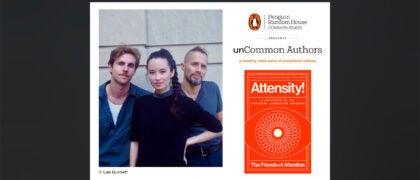
The Friends of Attention is a collective of activists, artists, and thinkers. Three editors and long-standing "Friends" helped Attensity! take shape: D. Graham Burnett is the Henry Charles Lea Professor of history of science at Princeton University. Alyssa Loh, a filmmaker, co-directed the short film “Twelve Theses on Attention.” Peter Schmidt is the Program Director of the Strother School of Radical Attention. View titles by The Friends of Attention

What's Attensity! about?

Classroom Activities for Attensity!

Classroom activities supplement discussion and traditional lessons with group projects and creative tasks. Can be used in pre-existing units and lessons, or as stand-alone.

(Please note: the guide displayed here is the most recently uploaded version; while unlikely, any page citation discrepancies between the guide and book is likely due to pagination differences between a book’s different formats.)

About

A rallying cry to fight the commodification of human attention, with the tools we need to reclaim our humanity, by a group of writers, artists, and activists in the vanguard of the movement

“A stirring battle cry on behalf of our shared humanity against the forces that seek to diminish and degrade it. Downright invigorating. Just what the moment calls for.”—Chris Hayes, author of The Sirens’ Call


We all feel it: something is seriously wrong. Our attention—that essential ability to give our minds and senses to the world—is being trapped, gutted, and sold out from under us by an industry of immense technological and financial power. The heedless exploitation of this vital capacity by a handful of tech companies is harming us all, reducing our very selfhood to that which can be quantified, bought, and sold—and shaking the foundations of our democracy.

To push back against this “human fracking,” we need more than individual willpower or isolated efforts. We need a movement of collective resistance. Such a movement is beginning to bloom, and in this radical, first-of-its-kind guide, The Friends of Attention show us how to join the fight. We meet welders, nurses, poets, and surfers, all of whom are engaged in attentional practices. We learn to seek out sanctuaries—theaters and museums, houses of worship, dance parties—where together we can take refuge from the frackers. Attention Activism takes our apocalyptic present, turns it on its head, and reveals new vistas of human flourishing.

Drawing on a rich legacy of critical intellectuals and the creative wisdom of diverse traditions, Attensity! calls on us to come together to defeat the greedy dehumanizing forces of brute instrumentalization—and re-enchant the world.

Excerpt

Chapter 1

Something is seriously wrong. It has to do with our ATTENTION, our essential ability to give our minds and senses to the world. This precious capacity has been channeled, captured, and commodified by an industry of immense technological and financial power. How? Call it “human fracking.”

Human fracking is bad for people, and for politics. It reduces our very beings (and our relationships) to that which can be quantified, bought, and sold. All this is the triumph of a catastrophic lie about what it means to be human. But deceit and exploitation are never inevitable. To push back, we need more than isolated, individual efforts; what we need is a movement of collective resistance.

This movement of attentional liberation exists and has a name: ATTENTION ACTIVISM.

Attention Activism is a fight for justice. This emancipatory uprising takes our apocalyptic present, turns it on its head, and creates, from the chaos and confusion, new vistas of human flourishing.

Attention Activism is rooted in STUDY—a commitment to diverse forms of teaching and learning centered on attention (what it is, what it can be, what it can do). Attention Activism also requires COALITION-BULIDING—collaboration and solidarity across a range of communities who see attention’s essential role in human flourishing. Finally, Attention Activism means the formation of SANCTUARIES—spaces where people can gather, care for each other, experiment with different kinds of attention, and conceive brighter futures.

To discern the revolutionary possibilities of the present, we look to artists, thinkers, and dreamers. To bring those possibilities to bloom, we heed the countless Attention Activists who are already out there, devising new (and revising old) ways of giving their minds and senses to each other and the world.

These attentionauts and attentionistas draw on the wisdom of diverse traditions. Across uncharted terrain, emerging practices of joint attention illuminate new horizons of shared political power. Not only power, but beauty, and grace, too.

This is our movement: the free movement of attention in its fullness, freely shared. We call that transformative goodness ATTENSITY. Join us in this heightened and heightening glory—or let us join you!

You are correct: Something is seriously wrong.

We are living in conditions contrary to basic wellness.

We feel it, too. We, too, are lonely, plagued by anomie, troubled by the sense of a fundamental disconnection between ourselves and what’s real. The world seems to have slanted sideways. The more we try to be in contact with the people and things that promise to sustain us, the more isolated we become.

But how could it be otherwise? It makes perfect sense that we do not know how to live when our actual people (our friends, coworkers, lovers, even family) increasingly come to us as pop-up snapshots served between advertisements; when our access to the world is determined by our consumer preference categories; when extractive digital networks shape every aspect of daily life; when we do CAPTCHA tests to prove our humanity. We do not know how to live when we are continuously needled by our feeds into anguish and outrage in relation to distant events and lives over which we have no control.

And yet we’re tired of watching our friends and family (and ourselves) fail to flourish under these conditions. We tire of seeing our people diagnosed with mental disorders—as though failing to flourish in inhuman conditions is some individual quirk, maladjustment, or malady.

It is all so obvious that it scarcely bears elaboration: We are living under conditions that are contrary to basic wellness—of ourselves, our communities, and our planet.

We, too, awaken our screens in the morning, and are accosted by headlines announcing epidemics of depression and alienation, the collapse of our most trusted institutions, and the breakdown of our planet’s basic ecological cycles. These harms are numerous and diverse, but they are characterized by a common trend toward dissociation, toward severing and solitude.

Consider: Over the past ten years, suicide attempts and feelings of persistent hopelessness among high school students have increased by a staggering 40 percent. Girls are at greater risk—one in ten American female teens actually attempted self-destruction in 2024, and studies suggest that nearly a third experienced suicidal ideation. Never before have young people found themselves to be so disconnected from the things that make life worthwhile. We are confronting a pandemic of loneliness, and an unprecedented spike in “deaths of despair.”

We see comparable changes in a political landscape ravaged by social rupture and polarization. Instead of the messy-but-hopeful “enactment of democracy,” we find ourselves discharging open sewers of contempt into the ever-widening gulf between one virtual silo and another—disintegrating our ability to recognize our common condition, achieve consensus amid conflict, and thereby overcome existential threats.

And the threats are existential. The steady advance of climate catastrophe has pitched forward into a full-frontal assault. We are, more than ever, undeniably enmeshed with the worlds of water and air and soil. Yet even as the urgency of our ecological condition batters our spirits with each wildfire, hurricane, or deranging balmy December day, we wonder if, perhaps, this is not so abnormal after all. If our bodily senses return us only to a state of mounting dread, can they be trusted?

What we love most is at stake. It’s enough to get anyone out of the chair and into the street!

But among the catastrophes of our present moment is that the very means by which these disasters are brought to our awareness—twenty-four-hour news, the ping of cascading notifications, the endless scroll—act not as a bridge into the world, but as the actual mechanisms of further isolation and distance. The more urgent our collective problems become, the less real they seem to be.

How is this possible?

How have we been separated from each other and the world—and even from ourselves—at the absolute historical apex of global communicative interconnection?

The answer, we believe, is surprisingly simple: The actual stuff of all connection—the true way we are present to being, beings, and everything else—is neither a network nor a device. It isn’t outrage, or, for that matter, hope. It isn’t blood, sweat, or tears, either. It is attention.

And they have seriously f***ed with our attention.

ATTENSITY!

A Manifesto of the Attention Liberation Movement

You are correct: Something is seriously wrong. It has to do with our ATTENTION, our essential ability to give our minds and senses to the world. This precious capacity has been channeled, captured, and commodified by an industry of immense technological and financial power. How? Call it “human fracking.”

Human fracking is bad for people, and for politics. It reduces our very beings (and our relationships) to that which can be quantified, bought, and sold. All this is the triumph of a catastrophic lie about what it means to be human. But deceit and exploitation are never inevitable. To push back, we need more than isolated, individual efforts; what we need is a movement of collective resistance.

This movement of attentional liberation exists and has a name: ATTENTION ACTIVISM.

Attention Activism is a fight for justice. This emancipatory uprising takes our apocalyptic present, turns it on its head, and creates, from the chaos and confusion, new vistas of human flourishing.

Attention Activism is rooted in STUDY—a commitment to diverse forms of teaching and learning centered on attention (what it is, what it can be, what it can do). Attention Activism also requires COALITION-BUILDING—collaboration and solidarity across a range of communities who see attention’s essential role in human flourishing. Finally, Attention Activism means the formation of SANCTUARIES—spaces where people can gather, care for each other, experiment with different kinds of attention, and conceive brighter futures.

To discern the revolutionary possibilities of the present, we look to artists, thinkers, and dreamers. To bring those possibilities to bloom, we heed the countless Attention Activists who are already out there, devising new (and revising old) ways of giving their minds and senses to each other and the world.

These attentionauts and attentionistas draw on the wisdom of diverse traditions. Across uncharted terrain, emerging practices of joint attention illuminate new horizons of shared political power. Not only power, but beauty, and grace, too.

This is our movement: the free movement of attention in its fullness, freely shared. We call that transformative goodness ATTENSITY. Join us in this heightened and heightening glory—or let us join you!

It has to do with our attention, our essential ability to give our minds and senses to the world.

In efforts to define attention, some emphasize its relationship to catalyzing action, while others emphasize its endless receptivity. We resolve the tension between these two definitions by offering a third.

What is attention? The experts do not agree. In fact, they actively contradict each other.

Praise

“A stirring battle cry on behalf of our shared humanity against the forces that seek to diminish and degrade it. Downright invigorating. Just what the moment calls for.”—Chris Hayes, author of The Sirens’ Call

Attensity! is about how to reclaim one of our most powerful and valuable qualities—our attention—through a path back to the human things that matter: community, care, imagination, and art.”—Nathan Heller, staff writer, The New Yorker

“With a lively, even joyful blend of philosophical seriousness and practical imagination, it invites us to see attention not as a private asset to be hoarded but as a shared capacity to be cultivated and protected.”—Kwame Anthony Appiah, author of Cosmopolitanism

Attensity! is a thrilling declaration of independence from tech’s tyranny over our human spirits. We feel the human and humane surge to renewed life through its call to each of us to reclaim ownership of our own attention.”—Danielle Allen, author of Our Declaration: A Reading of the Declaration of Independence in Defense of Equality

“It is not always that you come across a book that changes how you see the world. Attensity! is an extraordinary book—every chapter has revelations that will make you stop and reconsider how you are living your life and reclaim the life that we have been given.”—Tim Wu, author of The Age of Extraction and The Attention Merchants

Attensity! is an unprecedented, impassioned intervention in one of the urgent crises of the twenty-first century.”—Jonathan Crary, author of Scorched Earth

“An illuminating and liberating read.”—Rob Nixon, author of Slow Violence and the Environmentalism of the Poor

“This is an ambitious text that will demand much of all of us readers beyond the page. It is asking vital questions about the potential of rewiring our lives in a time of growing crisis, where avalanches of information and access threaten the present and future of care, of close attention.”—Hanif Abdurraqib, author of There’s Always This Year

“Pay attention: If you are human, you must read this book. Also, please note that the term ‘attention’ has been colonized and made to mean the opposite of what it used to. According to AI people, it now means clearing out context to make less work for pattern-finding algorithms. Don’t let algorithms clear YOU out.”—Jaron Lanier, author of You Are Not a Gadget

“An essential call to arms to fight back against the fracking of our minds—and an indispensable guide to reclaiming the human spirit.”—Tristan Harris, co-founder of the Center for Humane Technology

“Luminous . . . Attensity! is not just a book to be read—it’s a call to be answered, a vision to be embraced, a future to be built.”—James Williams, author of Stand Out of Our Light

Author

© Leo Burnett
The Friends of Attention is a collective of activists, artists, and thinkers. Three editors and long-standing "Friends" helped Attensity! take shape: D. Graham Burnett is the Henry Charles Lea Professor of history of science at Princeton University. Alyssa Loh, a filmmaker, co-directed the short film “Twelve Theses on Attention.” Peter Schmidt is the Program Director of the Strother School of Radical Attention. View titles by The Friends of Attention

Media

What's Attensity! about?

Guides

Classroom Activities for Attensity!

Classroom activities supplement discussion and traditional lessons with group projects and creative tasks. Can be used in pre-existing units and lessons, or as stand-alone.

(Please note: the guide displayed here is the most recently uploaded version; while unlikely, any page citation discrepancies between the guide and book is likely due to pagination differences between a book’s different formats.)

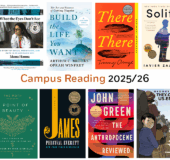
What Students Will Be Reading: Campus Common Reading Roundup, 2025-26

With the fall semester in full swing, colleges and universities around the country have announced their Common Reading books for the upcoming 2025-26 academic year. We’ve compiled a list of over 286 programs and their title selections from publicly available sources, which you can download here: First-Year Reading 2025-26. We will continue to update this

Read more

Register for the 2026 Penguin Random House First-Year Experience® Conference Author Events!

Penguin Random House Author Events at the 45th Annual First-Year Experience® Conference February 15-18, 2026 Seattle, Washington Hyatt Regency Seattle Click Here to RSVP A complimentary meal and a limited number of books will be available to attendees. Each event will also be followed by an author signing. Interested in hosting one of these authors at

Read more

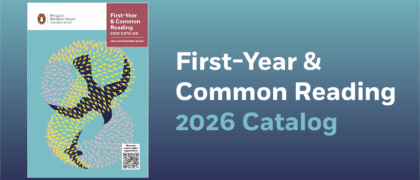
2026 Catalog for First-Year & Common Reading

We are delighted to present our new First-Year & Common Reading Catalog for 2026! From award-winning fiction, poetry, memoir, and biography to new books about the environment, current events, history, public health, science, social justice, student success, and technology, the titles presented in our common reading catalog will have students not only eagerly flipping through

Read more

unCommon Authors, an Author Video Series: ATTENSITY! by The Friends of Attention

PRH Education/Common Reads presents: unCommon Authors unCommon Authors is a monthly video series highlighting exceptional and unique authors talking about their books.   Attensity! is a rallying cry to fight the commodification of human attention, with the tools we need to reclaim our humanity, by a group of writers, artists, and activists in the vanguard

Read more