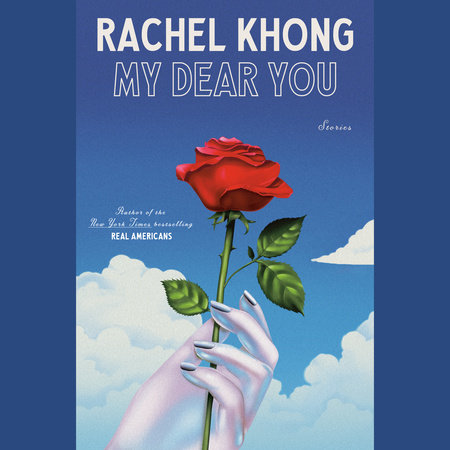
My Dear You

Stories

Author Rachel Khong On Tour
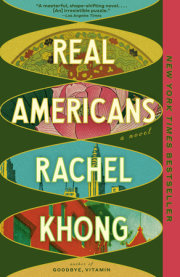
From the author of New York Times bestseller Real Americans, a brilliant short story collection about love, life, and the anguish of becoming oneself in a time when it’s so easy to be someone else

“I couldn’t stop reading these sly, poignant, very funny stories about intimacy and friendship, work and death, longing and connection. Rachel Khong’s writing is so agile and fluid and charming that it can sneak up on you and knock you out.” —Charles Yu, author of Interior Chinatown


The characters in My Dear You find themselves facing extraordinary choices in scenarios that range from the everyday to the absurd: The U.S. government injects all citizens with a drug that makes them see everyone else as members of their own race and gender. God does away with humans in favor of something much better. A woman adopts a cat who conjures the ghosts of her ex-loves. A factory worker decides to befriend a sex doll she is tasked with selling.

These stories go deep beneath the surface, touching on the particular awkwardness of dating in your thirties and asking: What does it mean to be an Asian woman in America? Or an American? Or a human? Along the way, the characters stop to consider interventions from the supernatural, the earthly, the robotic, and the immortal.

Playful, profane, and yet enveloped with profound compassion for life, however you define it, My Dear You takes on dating, marriage, and the pressures of having or not having children; intimacy, memory, race, and capitalism; living, dying, and being dead. At their very core, they are tales of love in its many forms: being in love when you’re not supposed to be, or not being in love but wishing you were; failing at dating apps or finding yourself in weird but wonderful lifelong friendships; struggling in heaven to remember your loved ones.

Ranging from the sinister to the tender, these witty and expertly paced stories will have you laughing out loud one minute and reaching for your best friend the next.
THE FRESHENING

My cashier’s black hair was beautiful. Though not unlike mine, it was shinier and thicker, and hung glamorously down to her waist. It looked strong, too, like Superman’s in the Christopher Reeve movies. A strand of Superman’s hair could hold up a thousand-pound weight. As a child, I watched those movies over and over: they were my favorite. Superman’s hair, holding up the weight, looks as thick as a wire. A whole head of his hairs must have been heavy. But Superman’s neck was so strong, I figured, the weight of his head didn’t matter.

“Enjoy your last evening,” my cashier said, adding “last” to distinguish this day, the same blithe way somebody might add “Happy holidays” to an email in December. With one hand, she flipped her lustrous hair off her shoulder.

She seemed youthful and careless. I guessed she was Filipina. She probably took her hair for granted, the way people in their twenties usually took their assets as givens. Then again, kids knew more these days.

She handed me my purchases in one bulging bag. I took them from her. If I’d been bagging the items myself I would have given myself two double bags. But I thanked her, added, “You, too,” and when she didn’t look away from the next customer, I went on my way.

***

At home, I removed the can of Pringles and one of the bottles of wine. I gave a cursory glance out the window to check for any neighbors—none—and pulled down my pants to stick a menstrual pad onto my underwear. I thumbed open the Pringles’s plastic top, peeled off the foil, and got to work eating them.

When I was told by my mother’s lawyer that she had left the house to me, my first thought had been that I would upgrade her full-size bed to a queen. I’m not proud of this, to have entertained this thought first, of all the possible thoughts. My second thought was that I was the worst. My third thought was not a thought at all but an overwhelming sadness. When I began to cry and found myself unable to stop, the lawyer had handed me a crumpled napkin from his pocket.

In life, my mother had not been unlike other immigrant mothers: demanding and exacting, unable to say the phrase I love you. Instead she talked about her immense sacrifice, how much she and my father had suffered to bring me to America, the land of opportunity, where everything turned out to be far more fucked up than she imagined. She never said “fucked up”—she didn’t curse—but it was in the subtext. She’d tell me how impressive her salary had been back in Taiwan. Here, her looks and way of speaking had been held against her. In the first few years of living in America, she’d had to clean toilets and showers at a twenty-four-hour gym, where the muscled men would openly stare at her butt. She fumed in silence, but she didn’t know enough English to ask them to stop.

Eventually, she lost her accent, and her English came to sound like any other American’s. Yet sometimes, when she didn’t want to be spoken to, she pretended not to understand. This was what people expected of an older Asian woman, so she played along.

My mother had been excited about the Freshening—the Identity Protection Act, as it was officially known. The trial runs had been positive—or positive enough. Now America, my mother felt, could truly be the land of opportunity. It was finally happening. Then she’d died—unfortunate timing.

I’d meant to drink the wine with the Pringles, but I got around to opening the wine only after I had eaten all the chips. I turned on the television and poured myself a glass to the rim.

A middle-aged woman reporter was at a college frat house, where bros in white-and-blue backward hats were partying. All across the country, people were celebrating the eve of the Freshening. They intended to stay up all night.

“It’s, like, our Y2K,” one bro said into the reporter’s microphone. Behind him, three bros were shotgunning Natural Lights and surrounding bros were rooting them on. I tried to picture each of the bros as a distinct individual with his own hopes and dreams but, I’ll be honest, I struggled to. It was a failure of my own imagination.

“We’re witnessing history,” another bro said. “I mean, it’s pretty special.”

***

We were each given a two-hour window in which the agents might come, like people installing Comcast, and mine was nine to eleven a.m. We were instructed to take the day off, but I would have been home anyway. I didn’t work anymore. From my mother I had inherited enough to live on forever.

At ten exactly my doorbell rang.

I opened the door to two men in black suits. They were tall and unexpectedly handsome. Their dark beards were trimmed close to their faces. One clasped a clear plastic clipboard, and the veins on his hand bulged beautifully, as though he were lifting a barbell.

“I’m Sal,” said the clipboard man, reaching his free hand toward mine to shake it. “And this is Diego.”

Diego gave a polite nod and tight smile, then glanced at Sal, who offered the smallest of nods in return. At first, they had resembled twins, but now I noticed the differences between them: Diego was older, his face more creased. I felt his cool wedding band against my hand. Sal’s skin was paler and his hair darker; Diego looked more Latino.

They launched into explaining the procedure, pausing every so often to ask if I had any questions. I shook my head. I’d already heard much of what they said because their spiel echoed the broadcasts on television. The procedure would be quick. It would be painless, or as painless as a regular flu shot. I wondered how many households they’d visited before mine, how many identical introductions they’d already given.

“Any questions?” Diego asked.

“I’m on my period,” I blurted.

“That’s fine,” Sal said. “That has no bearing.”

Sal unclasped his briefcase with two satisfying clicks and retrieved a set of rubber gloves. He snapped them on—they were tight on him—and rummaged for his other implements. I closed my eyes. I’m not a shot person.

I felt a hand gently brush my hair aside, away from my ears and to one side of my neck, and my eyes fluttered open for a moment, startled by the pleasantness of this contact. It was why I liked getting a haircut, that impersonal/personal touch.

“Hold still,” Sal said, and I reflexively nodded. He waited for my head to finish moving. He looked at Diego with a long-suffering expression. And though I was turned away, I pictured Sal communicating back, with his look, Just two hours to go.

A cool alcohol swab ran over my skin, then a quick pinch, and that was all. By the time I opened my eyes, Sal was snapping his gloves off. With what seemed to me tenderness, he moved my hair back over my shoulder.

“You can go about your day as you usually would,” Diego said.

“You might feel some dizziness or nausea, but that’s completely normal,” Sal said. “If anything worse happens, call the number on this pamphlet.”

“It’s a hotline,” Diego added. They stood.

On the front of the pamphlet was a smiling white woman hugging a smiling white child. The pamphlet was smooth and thick—high-quality. I wondered how much it had cost the country to print pamphlets for every American. A lot. But maybe it was a better use of tax dollars than many other things tax dollars were used for.

Starting today, babies born in American hospitals would receive this injection. Regular doses of medication—for maintenance—would be put into our water supply. It would be in the tap, it would be in our bottled water. I’d heard there were critics who found the entire undertaking questionable—it was racial segregation all over again, separate but equal taken to the most extreme—but those critics grudgingly agreed to it, because what choice did we have? The violence had gotten so bad.

***

As soon as the men left I changed back into my pajama pants. I noticed, with displeasure, that the pants were tighter. I hated shopping. I made a mental note that I would have to do something about that. Because of my mother, I’d always seen gyms as terrible places. I’d never set foot in one.

Go about your day as you usually would, the men had said. My usual days involved trading stocks and cryptocurrency, watching animal videos, and checking the messages on the online-dating services I used. My algae energy stock had gone up. My Ravencoin had gone down. A cat sat calmly on a running goat. The same four men sent me their same four penises.

Around eight p.m., I realized I hadn’t eaten all day, so I decided I’d venture out for a bite. I headed to the Wendy’s drive-through and ordered my regular burger.

“One Baconator,” the employee repeated through the speaker. “Any fries with that?”

“No fries,” I said. “Just the Baconator. And a chocolate Frosty.”

“Baconator and a Frosty,” she said and gave me my total.

When I pulled up to the food window, the employee who had taken my order repeated the price, and I gave her exact change. She kept her head down; her hair was pulled back and she was wearing a Wendy’s visor. When she looked up to give me my burger, I noticed she was Asian. She handed me the Frosty, then passed me a straw. I put the cold cup, with its condensation beginning to bead on its sides, into my cupholder, where it balanced on some trash.

At a stoplight, I glanced down at my burger bag. Instead of the regular Wendy, with her pinkish skin, red hair, and red freckles, this Wendy’s skin had a yellowish hue. Wendy’s
hair was black and Wendy’s face was wiped clean of red freckles. Wendy, I realized, looked like me.

I pulled over at the Walmart and parked. I ate my burger quickly, then chased it with the Frosty and gave myself a brain freeze.

Inside the Walmart, I saw the cashiers were all Asian women, and all the customers were Asian women with Asian daughters in shopping carts, or Asian women maneuvering around in motorized wheelchairs. In the toy aisle, all the Barbies had black hair like mine. In the electronics section, on the TVs, all the pop singers were Asian women.

The Freshening had begun.
“There’s a beautiful, effortless feel to these stories that makes them so highly readable (and I’m sure wasn’t effortless at all), and with it, Khong is able to sneak in abundant insights and a genuine depth that reveals itself unexpectedly. A thoroughly enjoyable collection.” —Aimee Bender, author of The Butterfly Lampshade

“I couldn’t stop reading these sly, poignant, very funny stories about intimacy and friendship, work and death, longing and connection. Rachel Khong’s writing is so agile and fluid and charming that it can sneak up on you and knock you out.” —Charles Yu, author of Interior Chinatown

“Rachel Khong is one of our best observers of the human condition and isn’t afraid to take us to unreal realms in order to illuminate the very real strangeness about being alive right now, in this specific moment. In these stories, ghosts haunt toilet tanks, girls turn into animals, the dead get to choose new bodies for the afterlife, and sex dolls become friends. These fearlessly funny and smart stories are a joy.” —Rita Bullwinkel, author of Headshot

My Dear You is a collection of wise stories whose wisdom sneaks up on you, delivered as it is in the guise of a joke. If this collection is a book of jokes, the jokes are the hysterical kind. You start out laughing, then realize you’re crying, without quite understanding what’s happened. Rachel Khong: comic, sage. I loved these bonkers stories so much.” —Vauhini Vara, author of This is Salvaged: Stories

My Dear You is a garden of bravura, incandescent and explosive and compassionate all at once. Khong’s stories astound and comfort, expanding the form’s possibilities, guiding us through the familiar, and the deeply unknowable, in spectacular form. Khong is one of my favorite writers; My Dear You is one of my favorite books.” —Bryan Washington, author of Palaver

“This collection is wonderful. The stories are a little quirky and comic, but also sharp and insightful.” —Chicago Review of Books

“The ten stories in the collection are all distinct and delightful, and will surely stick with you past the final page.” —Town & Country

“The 10 thought-provoking stories range from tender to sinister to funny to sad, and they won’t quickly leave readers’ minds.” —Library Journal (starred review)

“Each surprising, intricate, and emotionally resonant tale underscores a storytelling talent that’s all Khong’s own. Fans of Khong’s Goodbye Vitamin (2017) and Real Americans (2024), which was a Read with Jenna pick, will adore following the author’s imagination in these shorter tales.” —Booklist (starred review)

“In these provocative stories, Khong offers well-wrought and intricate depictions of Asian American and Asian life, often with a fantastical or speculative twist. . . . There’s much to admire in this assured collection.” —Publishers Weekly

“Khong writes tales of love in its many forms: being in love, not being in love, yearning to be in love, in the throes of unexpected yet wonderful lifelong friendships, and the intimate intertwining of love and grief. Read if you’re down to be existential.” —Electric Lit

“Surreal, profound, prophetic, playful, and provocative. . . . [Khong] uses the flexibility of the short-story form to wonderful and whimsical advantage.” Kirkus (starred review)

“These stories . . . blur the lines of genre in the vein of Marie-Helene Bertino and Kevin Wilson, with ghost-conjuring cats and strange government technology alongside the deeply human questions of what it means to be alive in a world that might not love you back.” Lit Hub

“There is always a remarkable economy of language in Rachel Khong’s books. She doesn’t waste any time—or any words—getting to the point, but she doesn’t sacrifice artistry, either.” Book Riot
© Andria Lo
Rachel Khong is the author of Goodbye, Vitamin, win­ner of the California Book Award for First Fiction. Real Americans, her second novel, was a New York Times best­seller. In 2018, Khong founded The Ruby, a work and event space for women and nonbinary writers and artists in San Francisco’s Mission District. With friends, she teaches creative writing as The Dream Side. She lives in Los Angeles. View titles by Rachel Khong

About

From the author of New York Times bestseller Real Americans, a brilliant short story collection about love, life, and the anguish of becoming oneself in a time when it’s so easy to be someone else

“I couldn’t stop reading these sly, poignant, very funny stories about intimacy and friendship, work and death, longing and connection. Rachel Khong’s writing is so agile and fluid and charming that it can sneak up on you and knock you out.” —Charles Yu, author of Interior Chinatown


The characters in My Dear You find themselves facing extraordinary choices in scenarios that range from the everyday to the absurd: The U.S. government injects all citizens with a drug that makes them see everyone else as members of their own race and gender. God does away with humans in favor of something much better. A woman adopts a cat who conjures the ghosts of her ex-loves. A factory worker decides to befriend a sex doll she is tasked with selling.

These stories go deep beneath the surface, touching on the particular awkwardness of dating in your thirties and asking: What does it mean to be an Asian woman in America? Or an American? Or a human? Along the way, the characters stop to consider interventions from the supernatural, the earthly, the robotic, and the immortal.

Playful, profane, and yet enveloped with profound compassion for life, however you define it, My Dear You takes on dating, marriage, and the pressures of having or not having children; intimacy, memory, race, and capitalism; living, dying, and being dead. At their very core, they are tales of love in its many forms: being in love when you’re not supposed to be, or not being in love but wishing you were; failing at dating apps or finding yourself in weird but wonderful lifelong friendships; struggling in heaven to remember your loved ones.

Ranging from the sinister to the tender, these witty and expertly paced stories will have you laughing out loud one minute and reaching for your best friend the next.

Excerpt

THE FRESHENING

My cashier’s black hair was beautiful. Though not unlike mine, it was shinier and thicker, and hung glamorously down to her waist. It looked strong, too, like Superman’s in the Christopher Reeve movies. A strand of Superman’s hair could hold up a thousand-pound weight. As a child, I watched those movies over and over: they were my favorite. Superman’s hair, holding up the weight, looks as thick as a wire. A whole head of his hairs must have been heavy. But Superman’s neck was so strong, I figured, the weight of his head didn’t matter.

“Enjoy your last evening,” my cashier said, adding “last” to distinguish this day, the same blithe way somebody might add “Happy holidays” to an email in December. With one hand, she flipped her lustrous hair off her shoulder.

She seemed youthful and careless. I guessed she was Filipina. She probably took her hair for granted, the way people in their twenties usually took their assets as givens. Then again, kids knew more these days.

She handed me my purchases in one bulging bag. I took them from her. If I’d been bagging the items myself I would have given myself two double bags. But I thanked her, added, “You, too,” and when she didn’t look away from the next customer, I went on my way.

***

At home, I removed the can of Pringles and one of the bottles of wine. I gave a cursory glance out the window to check for any neighbors—none—and pulled down my pants to stick a menstrual pad onto my underwear. I thumbed open the Pringles’s plastic top, peeled off the foil, and got to work eating them.

When I was told by my mother’s lawyer that she had left the house to me, my first thought had been that I would upgrade her full-size bed to a queen. I’m not proud of this, to have entertained this thought first, of all the possible thoughts. My second thought was that I was the worst. My third thought was not a thought at all but an overwhelming sadness. When I began to cry and found myself unable to stop, the lawyer had handed me a crumpled napkin from his pocket.

In life, my mother had not been unlike other immigrant mothers: demanding and exacting, unable to say the phrase I love you. Instead she talked about her immense sacrifice, how much she and my father had suffered to bring me to America, the land of opportunity, where everything turned out to be far more fucked up than she imagined. She never said “fucked up”—she didn’t curse—but it was in the subtext. She’d tell me how impressive her salary had been back in Taiwan. Here, her looks and way of speaking had been held against her. In the first few years of living in America, she’d had to clean toilets and showers at a twenty-four-hour gym, where the muscled men would openly stare at her butt. She fumed in silence, but she didn’t know enough English to ask them to stop.

Eventually, she lost her accent, and her English came to sound like any other American’s. Yet sometimes, when she didn’t want to be spoken to, she pretended not to understand. This was what people expected of an older Asian woman, so she played along.

My mother had been excited about the Freshening—the Identity Protection Act, as it was officially known. The trial runs had been positive—or positive enough. Now America, my mother felt, could truly be the land of opportunity. It was finally happening. Then she’d died—unfortunate timing.

I’d meant to drink the wine with the Pringles, but I got around to opening the wine only after I had eaten all the chips. I turned on the television and poured myself a glass to the rim.

A middle-aged woman reporter was at a college frat house, where bros in white-and-blue backward hats were partying. All across the country, people were celebrating the eve of the Freshening. They intended to stay up all night.

“It’s, like, our Y2K,” one bro said into the reporter’s microphone. Behind him, three bros were shotgunning Natural Lights and surrounding bros were rooting them on. I tried to picture each of the bros as a distinct individual with his own hopes and dreams but, I’ll be honest, I struggled to. It was a failure of my own imagination.

“We’re witnessing history,” another bro said. “I mean, it’s pretty special.”

***

We were each given a two-hour window in which the agents might come, like people installing Comcast, and mine was nine to eleven a.m. We were instructed to take the day off, but I would have been home anyway. I didn’t work anymore. From my mother I had inherited enough to live on forever.

At ten exactly my doorbell rang.

I opened the door to two men in black suits. They were tall and unexpectedly handsome. Their dark beards were trimmed close to their faces. One clasped a clear plastic clipboard, and the veins on his hand bulged beautifully, as though he were lifting a barbell.

“I’m Sal,” said the clipboard man, reaching his free hand toward mine to shake it. “And this is Diego.”

Diego gave a polite nod and tight smile, then glanced at Sal, who offered the smallest of nods in return. At first, they had resembled twins, but now I noticed the differences between them: Diego was older, his face more creased. I felt his cool wedding band against my hand. Sal’s skin was paler and his hair darker; Diego looked more Latino.

They launched into explaining the procedure, pausing every so often to ask if I had any questions. I shook my head. I’d already heard much of what they said because their spiel echoed the broadcasts on television. The procedure would be quick. It would be painless, or as painless as a regular flu shot. I wondered how many households they’d visited before mine, how many identical introductions they’d already given.

“Any questions?” Diego asked.

“I’m on my period,” I blurted.

“That’s fine,” Sal said. “That has no bearing.”

Sal unclasped his briefcase with two satisfying clicks and retrieved a set of rubber gloves. He snapped them on—they were tight on him—and rummaged for his other implements. I closed my eyes. I’m not a shot person.

I felt a hand gently brush my hair aside, away from my ears and to one side of my neck, and my eyes fluttered open for a moment, startled by the pleasantness of this contact. It was why I liked getting a haircut, that impersonal/personal touch.

“Hold still,” Sal said, and I reflexively nodded. He waited for my head to finish moving. He looked at Diego with a long-suffering expression. And though I was turned away, I pictured Sal communicating back, with his look, Just two hours to go.

A cool alcohol swab ran over my skin, then a quick pinch, and that was all. By the time I opened my eyes, Sal was snapping his gloves off. With what seemed to me tenderness, he moved my hair back over my shoulder.

“You can go about your day as you usually would,” Diego said.

“You might feel some dizziness or nausea, but that’s completely normal,” Sal said. “If anything worse happens, call the number on this pamphlet.”

“It’s a hotline,” Diego added. They stood.

On the front of the pamphlet was a smiling white woman hugging a smiling white child. The pamphlet was smooth and thick—high-quality. I wondered how much it had cost the country to print pamphlets for every American. A lot. But maybe it was a better use of tax dollars than many other things tax dollars were used for.

Starting today, babies born in American hospitals would receive this injection. Regular doses of medication—for maintenance—would be put into our water supply. It would be in the tap, it would be in our bottled water. I’d heard there were critics who found the entire undertaking questionable—it was racial segregation all over again, separate but equal taken to the most extreme—but those critics grudgingly agreed to it, because what choice did we have? The violence had gotten so bad.

***

As soon as the men left I changed back into my pajama pants. I noticed, with displeasure, that the pants were tighter. I hated shopping. I made a mental note that I would have to do something about that. Because of my mother, I’d always seen gyms as terrible places. I’d never set foot in one.

Go about your day as you usually would, the men had said. My usual days involved trading stocks and cryptocurrency, watching animal videos, and checking the messages on the online-dating services I used. My algae energy stock had gone up. My Ravencoin had gone down. A cat sat calmly on a running goat. The same four men sent me their same four penises.

Around eight p.m., I realized I hadn’t eaten all day, so I decided I’d venture out for a bite. I headed to the Wendy’s drive-through and ordered my regular burger.

“One Baconator,” the employee repeated through the speaker. “Any fries with that?”

“No fries,” I said. “Just the Baconator. And a chocolate Frosty.”

“Baconator and a Frosty,” she said and gave me my total.

When I pulled up to the food window, the employee who had taken my order repeated the price, and I gave her exact change. She kept her head down; her hair was pulled back and she was wearing a Wendy’s visor. When she looked up to give me my burger, I noticed she was Asian. She handed me the Frosty, then passed me a straw. I put the cold cup, with its condensation beginning to bead on its sides, into my cupholder, where it balanced on some trash.

At a stoplight, I glanced down at my burger bag. Instead of the regular Wendy, with her pinkish skin, red hair, and red freckles, this Wendy’s skin had a yellowish hue. Wendy’s
hair was black and Wendy’s face was wiped clean of red freckles. Wendy, I realized, looked like me.

I pulled over at the Walmart and parked. I ate my burger quickly, then chased it with the Frosty and gave myself a brain freeze.

Inside the Walmart, I saw the cashiers were all Asian women, and all the customers were Asian women with Asian daughters in shopping carts, or Asian women maneuvering around in motorized wheelchairs. In the toy aisle, all the Barbies had black hair like mine. In the electronics section, on the TVs, all the pop singers were Asian women.

The Freshening had begun.

Praise

“There’s a beautiful, effortless feel to these stories that makes them so highly readable (and I’m sure wasn’t effortless at all), and with it, Khong is able to sneak in abundant insights and a genuine depth that reveals itself unexpectedly. A thoroughly enjoyable collection.” —Aimee Bender, author of The Butterfly Lampshade

“I couldn’t stop reading these sly, poignant, very funny stories about intimacy and friendship, work and death, longing and connection. Rachel Khong’s writing is so agile and fluid and charming that it can sneak up on you and knock you out.” —Charles Yu, author of Interior Chinatown

“Rachel Khong is one of our best observers of the human condition and isn’t afraid to take us to unreal realms in order to illuminate the very real strangeness about being alive right now, in this specific moment. In these stories, ghosts haunt toilet tanks, girls turn into animals, the dead get to choose new bodies for the afterlife, and sex dolls become friends. These fearlessly funny and smart stories are a joy.” —Rita Bullwinkel, author of Headshot

My Dear You is a collection of wise stories whose wisdom sneaks up on you, delivered as it is in the guise of a joke. If this collection is a book of jokes, the jokes are the hysterical kind. You start out laughing, then realize you’re crying, without quite understanding what’s happened. Rachel Khong: comic, sage. I loved these bonkers stories so much.” —Vauhini Vara, author of This is Salvaged: Stories

My Dear You is a garden of bravura, incandescent and explosive and compassionate all at once. Khong’s stories astound and comfort, expanding the form’s possibilities, guiding us through the familiar, and the deeply unknowable, in spectacular form. Khong is one of my favorite writers; My Dear You is one of my favorite books.” —Bryan Washington, author of Palaver

“This collection is wonderful. The stories are a little quirky and comic, but also sharp and insightful.” —Chicago Review of Books

“The ten stories in the collection are all distinct and delightful, and will surely stick with you past the final page.” —Town & Country

“The 10 thought-provoking stories range from tender to sinister to funny to sad, and they won’t quickly leave readers’ minds.” —Library Journal (starred review)

“Each surprising, intricate, and emotionally resonant tale underscores a storytelling talent that’s all Khong’s own. Fans of Khong’s Goodbye Vitamin (2017) and Real Americans (2024), which was a Read with Jenna pick, will adore following the author’s imagination in these shorter tales.” —Booklist (starred review)

“In these provocative stories, Khong offers well-wrought and intricate depictions of Asian American and Asian life, often with a fantastical or speculative twist. . . . There’s much to admire in this assured collection.” —Publishers Weekly

“Khong writes tales of love in its many forms: being in love, not being in love, yearning to be in love, in the throes of unexpected yet wonderful lifelong friendships, and the intimate intertwining of love and grief. Read if you’re down to be existential.” —Electric Lit

“Surreal, profound, prophetic, playful, and provocative. . . . [Khong] uses the flexibility of the short-story form to wonderful and whimsical advantage.” Kirkus (starred review)

“These stories . . . blur the lines of genre in the vein of Marie-Helene Bertino and Kevin Wilson, with ghost-conjuring cats and strange government technology alongside the deeply human questions of what it means to be alive in a world that might not love you back.” Lit Hub

“There is always a remarkable economy of language in Rachel Khong’s books. She doesn’t waste any time—or any words—getting to the point, but she doesn’t sacrifice artistry, either.” Book Riot

Author

© Andria Lo
Rachel Khong is the author of Goodbye, Vitamin, win­ner of the California Book Award for First Fiction. Real Americans, her second novel, was a New York Times best­seller. In 2018, Khong founded The Ruby, a work and event space for women and nonbinary writers and artists in San Francisco’s Mission District. With friends, she teaches creative writing as The Dream Side. She lives in Los Angeles. View titles by Rachel Khong

What Students Will Be Reading: Campus Common Reading Roundup, 2025-26

With the fall semester in full swing, colleges and universities around the country have announced their Common Reading books for the upcoming 2025-26 academic year. We’ve compiled a list of over 286 programs and their title selections from publicly available sources, which you can download here: First-Year Reading 2025-26. We will continue to update this

Read more

2026 Catalog for First-Year & Common Reading

We are delighted to present our new First-Year & Common Reading Catalog for 2026! From award-winning fiction, poetry, memoir, and biography to new books about the environment, current events, history, public health, science, social justice, student success, and technology, the titles presented in our common reading catalog will have students not only eagerly flipping through

Read more