Download high-resolution image Look inside
Listen to a clip from the audiobook
audio pause button
0:00
0:00

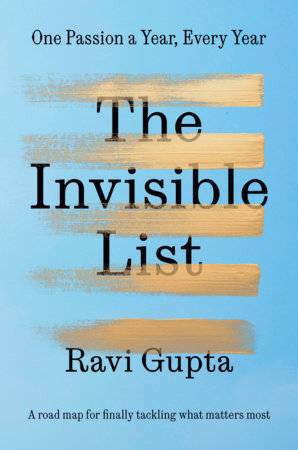
The Invisible List

One Passion a Year, Every Year

Author Ravi Gupta
Look inside
Listen to a clip from the audiobook
audio pause button
0:00
0:00
Transform hobbies to habits in this guide to pursuing the things you never thought you had time for, right now.

“With a blend of memoir, motivation, and actionable strategy, Ravi Gupta shares how a high-achieving life left him burned-out, unfulfilled, and disconnected—and how he reignited his spirit by dedicating himself to learning a single skill each year.”—Charles Duhigg, New York Times bestselling author of Supercommunicators and The Power of Habit

We all have an “invisible list” of things that we say we’ll do when we finally have the time: learn guitar, take up tennis, write a book, plant a butterfly garden. But life—jobs, families, the obligations of being a person—always gets in the way. The Invisible List is a blueprint for making those goals real. And the first step? Giving yourself permission.

From educator and civic entrepreneur Ravi Gupta comes a bold, inspiring approach to resurrecting your passions, no matter how limited your time or money. After realizing that he had stopped doing anything for the sheer love of it, Gupta shifted course and decided to dedicate a full year to becoming competent in one of his long-deferred hobbies. No quitting allowed. It soon became a yearly pursuit that has included taking on screenwriting, surfing, and powerlifting—and has led him to find new friends and a new focus and to discover that he is never too old to learn new things. Drawing on his successes as well as setbacks, Gupta shares how to create and fulfill your own invisible list, introducing concepts like

• THE LAUNCHPAD: a building-block skill that gets you in shape for more challenging years
• THE ANYWHERE, ANYTIME: an easy-to-access, affordable, and practical pursuit
• THE MENTAL MARATHON: a mind-sharpening hobby that grows your memory
• THE BIG ONE: something that takes a lot of time and resources—not impossible but requires planning
• THE GIVEBACK: an undertaking that builds community, empathy, and relationships

Part memoir, part guidebook, part manifesto, The Invisible List illustrates how to create a life worth living.
Chapter One

The Visible List

Imagine you’re walking down the street, and you pass a basketball court. A bunch of people are shooting pickup, and you linger, watching them. You used to love basketball when you were a kid, but you haven’t set foot on a court in years. Then you realize some of the players are around your age. For a moment, you imagine yourself joining them.

Before you know it, you walk through the gate, whip off your track pants to reveal gym shorts, and call out, “I got next!” Soon, the years are falling away. You’re slicing through defenders, posting up, and knocking down jumpers.

Yeah, right.

Be honest. As soon as you imagined playing, your mind filled with reasons you couldn’t. The version of you that could shoot, let alone jump and cut, is long gone. And even if you are in good shape, you don’t know these people. They all seem like friends. You don’t even understand how pickup etiquette works these days. Are you supposed to just walk over there and ask to sub in? And if you do, you know you’ll just embarrass yourself. You’re not in high school anymore. You can’t keep up with these athletes. You’re more likely to throw out your back than make a shot.

So you keep walking. “It would be nice,” you think, “but that’s not my life.” And basketball just becomes one more item on the mental list of things you’ve always wanted to pursue but never seem to find the time for.

We all have that list. It’s not written down or neatly organized. It just floats there in your subconscious like a half-­inflated balloon, bumping against the ceiling every now and then, reminding you it exists. For some people, the list is too painful to acknowledge, like a college sweatshirt from a school you didn’t get into. But the fact that you’re reading this book means you’re at least curious about dusting that list off. Maybe even doing something with it.

Begin by setting aside an hour to brainstorm your list. Sixty minutes may seem like overkill, but we’re talking about the rest of your life here. Chances are, your imagination is a bit out of practice. Research shows that our ability to daydream declines with age. Psychologist Leonard Giambra, in Experimental Gerontology, found that as we age, we have fewer “spontaneous thought intrusions,” which are basically those random, delightful brain tangents that lead to daydreaming. In other words: unless you make time for it, your brain’s going to stay on the same five topics it’s been looping since 2016.

So before you scribble down your dreams, let’s warm up. Loosen those mental hamstrings. The goal here is to shake off the weight and cynicism of adulthood and try to see the world with uncorrupted eyes again. Kids are naturals at this; they tumble into new endeavors without fear or judgment. Adults, not so much. But when we allow ourselves that kind of youthful innocence, even briefly, we make space for possibility again.

If that sounds a little too idealistic for adult life, consider Fred Astaire. Yes, that Fred Astaire—­the tap-­dancing movie legend. When he was deep into his seventies, he got curious about a new trend spreading across California: skateboarding. So he did what any seventy-­seven-­year-­old icon might do: he grabbed a board and started skating. And he loved it. So much so that he raved to Merv Griffin about it on TV and was even granted a lifetime membership in the National Skateboard Society of America. A local skating magazine quoted him as saying that he “exercised daily” on his board. He got so good at it that a year later, he invited his family to watch him attempt a new trick: a handstand on the board.

Did he wipe out and break his wrist? Absolutely. Yet we shouldn’t overlook the fact that before he ate it, for a moment, seventy-­eight-­year-­old Fred Astaire was doing a handstand on a skateboard.

We will all get old. We don’t all have to give up. We can choose to live a passionate life, learning and growing far longer than we ever expected to. This is about so much more than New Year’s resolutions or career advancement. It’s about identity and purpose.

That’s the spirit we’re channeling now. Not ambition for ambition’s sake, but curiosity without baggage. So before you begin building your list, take a moment to reconnect with that part of yourself. Ask:

1. What did you love to do as a kid that you’ve stopped doing?

2. When have you felt most alive?

3. What activities or sports make you think, “I wish I could do that”?

4. What creative works don’t just move you—­but make you want more from yourself?

Sit with these questions. Don’t treat it like homework. Let it flow.

The goal isn’t perfection; it’s to spark something—­to remember the moments when you felt free, curious, or utterly absorbed. Those memories are the breadcrumbs leading back to the parts of yourself you’ve lost along the way.

Let’s honor that. Grab a notebook or a blank sheet of paper. Stash your phone in another room, out of sight and out of mind. It’ll be okay.

Now it’s time to write down your list.

Start with the items you’ve long had in your head. This shouldn’t take long. They’re likely things you’ve attempted and never finished.

Once you’ve listed the obvious items, dig deeper. Think back to when your imagination wasn’t boxed in by deadlines, bills, or the judgment of others. Back then, everything felt possible—­what you wanted to do, who you wanted to be. Somewhere along the way, though, most of us lose that sense of limitless curiosity. Instead of wondering what’s next, we tell ourselves why it’s too late.

Richard Linklater opens his film Slacker (1990) with a character musing: “It’s like every choice or decision you make . . . the thing you choose not to do . . . fractions off and becomes its own reality . . . and just goes on from there forever.” Without a plan, those dreams wander off into some parallel life you’ll never live. And there they stay.

That’s why it’s essential to write down the entire list, not only basketball or whatever comes to mind first. By capturing all your potential passions, you’re telling yourself you’ll eventually make space in your life for them. And this isn’t just a technical exercise; it’s a spiritual journey. A chance to reconnect with the kid who thought they could do or be anything.
“In The Invisible List, Ravi Gupta confronts the quiet backlog of the dreams we all carry. With a blend of memoir, motivation, and actionable strategy, Gupta shares how a high-achieving life left him burned-out, unfulfilled, and disconnected—and how he reignited his spirit by dedicating himself to learning a single skill each year. This is a blueprint for joyfully rewriting your story, one passion at a time.”—Charles Duhigg, New York Times bestselling author of Supercommunicators and The Power of Habit

“An earnest dedication to mastering new skills.”—The Wall Street Journal

“In my work as a therapist, I see how often people defer their dreams until conditions are perfect—which means forever. Ravi Gupta knows this trap intimately, and he’s offered us a profound gift: the compassionate mirror and practical map we need to make the most of our lives now.”—Lori Gottlieb, New York Times bestselling author of Maybe You Should Talk to Someone

“Gupta gave me permission and a plan to rewild my yard—something I’ve always wanted to do but never quite dared. Full of inspiration and practical, tactical advice, The Invisible List will prove to you that you don’t have to wait any longer to do that thing you’ve always wanted to do.”—Kim Scott, New York Times bestselling author of Radical Candor

“This stunning book had me gripped from page one. The Invisible List is brilliant, hilarious, bracingly insightful, and genuinely mind-opening. Ravi Gupta is an irresistible writer, and this book will actually change your life.”—Amy Chua, Yale law professor and New York Times bestselling author of Battle Hymn of the Tiger Mother and The Golden Gate

“The Invisible List is as inspiring as it is practical—a framework for making your next ten years deliberate and meaningful.”—Gabe Wyner, bestselling author of Fluent Forever

“WARNING: Cracking open this book means you are likely to crack open yourself—your deepest doubts, desires, insecurities, and that whole new world you secretly want to conquer. If you’ve been trying to choose between grind and growth and, in your heart of hearts, want to choose the latter, here’s your answer. And a road map.”—Lenore Skenazy, author of Free-Range Kids

“Ravi Gupta reminds us that learning doesn’t end with school or early adulthood—and that it is never too late to become serious learners again. The Invisible List is a generous, practical, and deeply human book about reclaiming dormant passions and building a life of continued growth.”—John B. King, Jr., former U.S. Secretary of Education and current chancellor of the State University of New York

“A book about all the dreams that lie dormant within us and how to bring them into reality . . . It may just inspire you to start something you’ve been holding back on.”—Scott H. Young, author of Ultralearning

“Readers waiting for ‘someday’ will be inspired to finally start pursuing their dreams.”—Publishers Weekly

“This just might be the kickstart readers need.”—Booklist
© Cherie Tao
Ravi Gupta is a serial entrepreneur across education, politics, media, and health. He is the co-founder of Arena, RePublic Schools, and Squadra Health. He currently leads The Branch, a nonprofit media company. A former school principal and Obama staffer, Gupta has appeared in Time, The New Republic, Wired, and more. His podcasts reach over 300,000 weekly listeners, and he is a Forbes 30 Under 30 alum, a Truman Scholar, and a Yale Law School graduate. He was born and raised in New York City. View titles by Ravi Gupta

About

Transform hobbies to habits in this guide to pursuing the things you never thought you had time for, right now.

“With a blend of memoir, motivation, and actionable strategy, Ravi Gupta shares how a high-achieving life left him burned-out, unfulfilled, and disconnected—and how he reignited his spirit by dedicating himself to learning a single skill each year.”—Charles Duhigg, New York Times bestselling author of Supercommunicators and The Power of Habit

We all have an “invisible list” of things that we say we’ll do when we finally have the time: learn guitar, take up tennis, write a book, plant a butterfly garden. But life—jobs, families, the obligations of being a person—always gets in the way. The Invisible List is a blueprint for making those goals real. And the first step? Giving yourself permission.

From educator and civic entrepreneur Ravi Gupta comes a bold, inspiring approach to resurrecting your passions, no matter how limited your time or money. After realizing that he had stopped doing anything for the sheer love of it, Gupta shifted course and decided to dedicate a full year to becoming competent in one of his long-deferred hobbies. No quitting allowed. It soon became a yearly pursuit that has included taking on screenwriting, surfing, and powerlifting—and has led him to find new friends and a new focus and to discover that he is never too old to learn new things. Drawing on his successes as well as setbacks, Gupta shares how to create and fulfill your own invisible list, introducing concepts like

• THE LAUNCHPAD: a building-block skill that gets you in shape for more challenging years
• THE ANYWHERE, ANYTIME: an easy-to-access, affordable, and practical pursuit
• THE MENTAL MARATHON: a mind-sharpening hobby that grows your memory
• THE BIG ONE: something that takes a lot of time and resources—not impossible but requires planning
• THE GIVEBACK: an undertaking that builds community, empathy, and relationships

Part memoir, part guidebook, part manifesto, The Invisible List illustrates how to create a life worth living.

Excerpt

Chapter One

The Visible List

Imagine you’re walking down the street, and you pass a basketball court. A bunch of people are shooting pickup, and you linger, watching them. You used to love basketball when you were a kid, but you haven’t set foot on a court in years. Then you realize some of the players are around your age. For a moment, you imagine yourself joining them.

Before you know it, you walk through the gate, whip off your track pants to reveal gym shorts, and call out, “I got next!” Soon, the years are falling away. You’re slicing through defenders, posting up, and knocking down jumpers.

Yeah, right.

Be honest. As soon as you imagined playing, your mind filled with reasons you couldn’t. The version of you that could shoot, let alone jump and cut, is long gone. And even if you are in good shape, you don’t know these people. They all seem like friends. You don’t even understand how pickup etiquette works these days. Are you supposed to just walk over there and ask to sub in? And if you do, you know you’ll just embarrass yourself. You’re not in high school anymore. You can’t keep up with these athletes. You’re more likely to throw out your back than make a shot.

So you keep walking. “It would be nice,” you think, “but that’s not my life.” And basketball just becomes one more item on the mental list of things you’ve always wanted to pursue but never seem to find the time for.

We all have that list. It’s not written down or neatly organized. It just floats there in your subconscious like a half-­inflated balloon, bumping against the ceiling every now and then, reminding you it exists. For some people, the list is too painful to acknowledge, like a college sweatshirt from a school you didn’t get into. But the fact that you’re reading this book means you’re at least curious about dusting that list off. Maybe even doing something with it.

Begin by setting aside an hour to brainstorm your list. Sixty minutes may seem like overkill, but we’re talking about the rest of your life here. Chances are, your imagination is a bit out of practice. Research shows that our ability to daydream declines with age. Psychologist Leonard Giambra, in Experimental Gerontology, found that as we age, we have fewer “spontaneous thought intrusions,” which are basically those random, delightful brain tangents that lead to daydreaming. In other words: unless you make time for it, your brain’s going to stay on the same five topics it’s been looping since 2016.

So before you scribble down your dreams, let’s warm up. Loosen those mental hamstrings. The goal here is to shake off the weight and cynicism of adulthood and try to see the world with uncorrupted eyes again. Kids are naturals at this; they tumble into new endeavors without fear or judgment. Adults, not so much. But when we allow ourselves that kind of youthful innocence, even briefly, we make space for possibility again.

If that sounds a little too idealistic for adult life, consider Fred Astaire. Yes, that Fred Astaire—­the tap-­dancing movie legend. When he was deep into his seventies, he got curious about a new trend spreading across California: skateboarding. So he did what any seventy-­seven-­year-­old icon might do: he grabbed a board and started skating. And he loved it. So much so that he raved to Merv Griffin about it on TV and was even granted a lifetime membership in the National Skateboard Society of America. A local skating magazine quoted him as saying that he “exercised daily” on his board. He got so good at it that a year later, he invited his family to watch him attempt a new trick: a handstand on the board.

Did he wipe out and break his wrist? Absolutely. Yet we shouldn’t overlook the fact that before he ate it, for a moment, seventy-­eight-­year-­old Fred Astaire was doing a handstand on a skateboard.

We will all get old. We don’t all have to give up. We can choose to live a passionate life, learning and growing far longer than we ever expected to. This is about so much more than New Year’s resolutions or career advancement. It’s about identity and purpose.

That’s the spirit we’re channeling now. Not ambition for ambition’s sake, but curiosity without baggage. So before you begin building your list, take a moment to reconnect with that part of yourself. Ask:

1. What did you love to do as a kid that you’ve stopped doing?

2. When have you felt most alive?

3. What activities or sports make you think, “I wish I could do that”?

4. What creative works don’t just move you—­but make you want more from yourself?

Sit with these questions. Don’t treat it like homework. Let it flow.

The goal isn’t perfection; it’s to spark something—­to remember the moments when you felt free, curious, or utterly absorbed. Those memories are the breadcrumbs leading back to the parts of yourself you’ve lost along the way.

Let’s honor that. Grab a notebook or a blank sheet of paper. Stash your phone in another room, out of sight and out of mind. It’ll be okay.

Now it’s time to write down your list.

Start with the items you’ve long had in your head. This shouldn’t take long. They’re likely things you’ve attempted and never finished.

Once you’ve listed the obvious items, dig deeper. Think back to when your imagination wasn’t boxed in by deadlines, bills, or the judgment of others. Back then, everything felt possible—­what you wanted to do, who you wanted to be. Somewhere along the way, though, most of us lose that sense of limitless curiosity. Instead of wondering what’s next, we tell ourselves why it’s too late.

Richard Linklater opens his film Slacker (1990) with a character musing: “It’s like every choice or decision you make . . . the thing you choose not to do . . . fractions off and becomes its own reality . . . and just goes on from there forever.” Without a plan, those dreams wander off into some parallel life you’ll never live. And there they stay.

That’s why it’s essential to write down the entire list, not only basketball or whatever comes to mind first. By capturing all your potential passions, you’re telling yourself you’ll eventually make space in your life for them. And this isn’t just a technical exercise; it’s a spiritual journey. A chance to reconnect with the kid who thought they could do or be anything.

Praise

“In The Invisible List, Ravi Gupta confronts the quiet backlog of the dreams we all carry. With a blend of memoir, motivation, and actionable strategy, Gupta shares how a high-achieving life left him burned-out, unfulfilled, and disconnected—and how he reignited his spirit by dedicating himself to learning a single skill each year. This is a blueprint for joyfully rewriting your story, one passion at a time.”—Charles Duhigg, New York Times bestselling author of Supercommunicators and The Power of Habit

“An earnest dedication to mastering new skills.”—The Wall Street Journal

“In my work as a therapist, I see how often people defer their dreams until conditions are perfect—which means forever. Ravi Gupta knows this trap intimately, and he’s offered us a profound gift: the compassionate mirror and practical map we need to make the most of our lives now.”—Lori Gottlieb, New York Times bestselling author of Maybe You Should Talk to Someone

“Gupta gave me permission and a plan to rewild my yard—something I’ve always wanted to do but never quite dared. Full of inspiration and practical, tactical advice, The Invisible List will prove to you that you don’t have to wait any longer to do that thing you’ve always wanted to do.”—Kim Scott, New York Times bestselling author of Radical Candor

“This stunning book had me gripped from page one. The Invisible List is brilliant, hilarious, bracingly insightful, and genuinely mind-opening. Ravi Gupta is an irresistible writer, and this book will actually change your life.”—Amy Chua, Yale law professor and New York Times bestselling author of Battle Hymn of the Tiger Mother and The Golden Gate

“The Invisible List is as inspiring as it is practical—a framework for making your next ten years deliberate and meaningful.”—Gabe Wyner, bestselling author of Fluent Forever

“WARNING: Cracking open this book means you are likely to crack open yourself—your deepest doubts, desires, insecurities, and that whole new world you secretly want to conquer. If you’ve been trying to choose between grind and growth and, in your heart of hearts, want to choose the latter, here’s your answer. And a road map.”—Lenore Skenazy, author of Free-Range Kids

“Ravi Gupta reminds us that learning doesn’t end with school or early adulthood—and that it is never too late to become serious learners again. The Invisible List is a generous, practical, and deeply human book about reclaiming dormant passions and building a life of continued growth.”—John B. King, Jr., former U.S. Secretary of Education and current chancellor of the State University of New York

“A book about all the dreams that lie dormant within us and how to bring them into reality . . . It may just inspire you to start something you’ve been holding back on.”—Scott H. Young, author of Ultralearning

“Readers waiting for ‘someday’ will be inspired to finally start pursuing their dreams.”—Publishers Weekly

“This just might be the kickstart readers need.”—Booklist

Author

© Cherie Tao
Ravi Gupta is a serial entrepreneur across education, politics, media, and health. He is the co-founder of Arena, RePublic Schools, and Squadra Health. He currently leads The Branch, a nonprofit media company. A former school principal and Obama staffer, Gupta has appeared in Time, The New Republic, Wired, and more. His podcasts reach over 300,000 weekly listeners, and he is a Forbes 30 Under 30 alum, a Truman Scholar, and a Yale Law School graduate. He was born and raised in New York City. View titles by Ravi Gupta

What Students Will Be Reading: Campus Common Reading Roundup, 2026–27

With the fall semester in full swing, colleges and universities across the country have announced their Common Reading books for the 2026–27 academic year. We’ve compiled a list of over 250 programs and their title selections, detailed below. We will continue to update this listing to provide the most comprehensive record of programs available anywhere

Read more

2027 Catalog for First-Year & Common Reading

We are delighted to present our new First-Year & Common Reading Catalog for 2027! From award-winning fiction, poetry, memoir, and biography to new books about the environment, current events, history, public health, science, social justice, student success, and technology, the titles presented in our common reading catalog will have students not only eagerly flipping through

Read more

Videos from the 2026 First-Year Experience® Conference are now available

We’re pleased to share videos from the 2026 First-Year Experience® Conference. Whether you weren’t able to join us at the conference or would simply like to hear the talks again, please take a moment to view the clips below.   Penguin Random House Author Breakfast Monday, February 17th, 7:15 – 8:45 am PST   This

Read more

unCommon Authors, an Author Video Series: THE INVISIBLE LIST by Ravi Gupta

Penguin Random House/Common Reads presents: unCommon Authors unCommon Authors is a monthly video series highlighting exceptional and unique authors talking about their books. Ravi Gupta, educator, civic entrepreneur, and author of The Invisible List, teaches us how to transform hobbies to habits in a book that is part memoir, part guidebook, part manifesto.   Ravi

Read more