Download high-resolution image Look inside
Listen to a clip from the audiobook
audio pause button
0:00
0:00

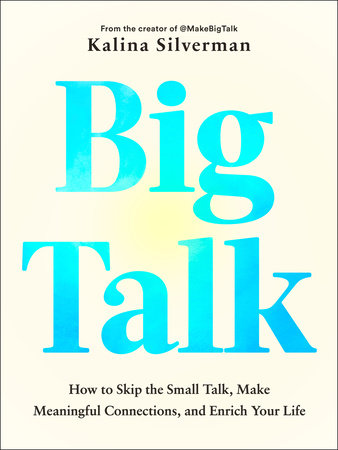
Big Talk

How to Skip the Small Talk, Make Meaningful Connections, and Enrich Your Life

Look inside
Listen to a clip from the audiobook
audio pause button
0:00
0:00
Hardcover
$30.00 US
On sale Feb 24, 2026 | 288 Pages | 9780593855317

See Additional Formats
From the wildly popular and innovative creator of @MakeBigTalk, a practical and comprehensive guide to forming deeper connections to combat loneliness and strengthen existing relationships

Our world is increasingly connected—yet so many people feel alone and without purpose. Big Talk offers a powerful antidote. With simple tools and inspiring real-life stories, Kalina Silverman shares how you can go beyond small talk and unlock hidden emotional depths in everyday interactions—whether with a stranger, a friend, a coworker, a community member, a family member, a partner, or even yourself.

What began as one young woman’s mission to fight loneliness has since grown into a global movement, featured in major media and used in schools, workplaces, governments, and communities around the world.

In this book, Silverman distills more than a decade of insights from “making Big Talk” into easy-to-apply questions, prompts, and techniques that will help you:

  • overcome social anxiety and start more meaningful conversations;
  • deepen relationships and build new ones that last;
  • foster empathy, trust, and belonging in your community;
  • create spaces where truth, vulnerability, and real connection can thrive; and make everyday moments, from date nights, to workplace chats, to vacations, to neighborly exchanges, more meaningful and memorable.
Concise, practical, and full of heart, Big Talk is for anyone who’s tired of small talk and ready to have conversations that matter.
1

Big Talk 101

Remember that everyone you meet is afraid of something, loves something, and has lost something.
-H. Jackson Brown, The Complete Life's
Little Instruction Book

My approach to teaching Big Talk is built more on personal encounters than academic theories. In fact, the word educator comes from the Latin word educare, which means "to bring out what is within." In that spirit, I'm here with you-not as an instructor, but as a guide and fellow human-helping to draw out what's already within you!

Thousands of conversations have shaped the ideas and lessons in this book. I've discovered that genuine connection can happen anywhere, with anyone. By sharing stories, reflections, and moments that have moved me, I hope to help you open a path toward deeper connection.

Do it now.

On a sunlit walk with a friend in Venice Beach, an English couple stopped to ask me for directions. We struck up a conversation and moved past small talk, diving into Big Talk.

Big Talk: What is a brave choice you're glad you made?

English woman: Some years ago, I was promoted to the job I had been trying to get for five years. Sadly, at that time, my youngest sister was diagnosed with terminal cancer. I remember when we were little kids, we used to play together with our teddy bears.

I decided to give up the job to look after her. We spent her last few weeks together.

I'm glad I made that decision, which I think is part of my "Do it now" philosophy. Because she was just forty-nine when she died. Literally, on her deathbed, she listed all the things she hadn't done. Because at forty-nine, you haven't done everything you wanted to do. So, if you've got a bucket list, do it; do it now. Don't wait. Too many people put things off, and you never know what's around the corner. So, take advantage of being alive today, and don't put things off. Do it now.

This conversation reminded me what matters most in life: being there with the people you love and following your heart.

As Albert Einstein said, "Everything should be made as simple as possible, but not simpler." This book aims to simplify the process of making meaningful connections while still honoring their significance.

Before we dive deep, we'll start with the basics. Think of this chapter as a primer or tool kit-a collection of ideas and practical tips to help you build a strong foundation for making Big Talk. In the chapters ahead, we'll explore the nuances, concepts, and deeper stories that transform Big Talk from conversation into connection.

Everyone has the ability-and the right-to build deeper connections. You don't need to be an extrovert or a community leader, in therapy, or studying communications. You just need to be open to talking and listening to people.

Even if some people seem unapproachable or distant, remember that they, too, like everyone else, may silently carry a fond memory, ceaseless worry, or life dream.

Sometimes, I like to think of connection as a series of simple "equations" that capture the essence of meaningful interactions:

Curiosity + Empathy = A Big Talk Conversation

A Shared Experience + Openness to Others = A New Relationship

Shared Celebrations and Struggles + Collaboration = Community Building

These equations can help us frame social interactions to foster connection. Whether starting a conversation or strengthening a relationship, the key ingredients are always curiosity, openness, sharing, and empathy.

Before we get into the mechanics of making Big Talk, let's talk about what Big Talk actually is (and isn't).

Big Talk is:


  • A communication approach for moving past small talk to ask deeper, more substantive questions and to make more meaningful life connections with just about anybody.
  • A pathway to strengthening interpersonal relationships and building friendships.
  • A storytelling tool to foster curiosity and empathy.
  • A community-building tool to enhance belonging.
  • An activity for self-reflection.

Big Talk is not:


  • An excuse to step across people's boundaries and/or dive into political opinions.
  • A therapy session or substitute for professional mental health support.
  • A platform for dominating conversations or proving a point.
  • A one-size-fits-all approach-every conversation should adapt to the comfort and context of the people involved.
  • A quick fix for building deep relationships, which takes time and genuine effort.

Remember that Big Talk doesn't always involve long, philosophical conversations, nor does it force others into uncomfortable, deep discussions. The goal is to make room for connection without pressure and allow exchanges to happen naturally.

So you may be wondering, how does one make Big Talk? Big Talk begins with the art of asking questions. There are three simple guidelines for what makes a question "Big Talk."

Big Talk questions are:

Open-ended: They invite more than a factual or "yes or no" response.

Universal: Any human being can answer them, no matter who they are or what they do. Big Talk conversations connect rather than divide.

Story-eliciting: Everyone would have a unique answer to the question, which invites people to share personal life experiences rather than discuss the outside world (e.g., the news or politics).

If asking a profound question feels awkward to you, gradually move from small talk to Big Talk. If you still feel strange about it, tell the person that you are reading a book called Big Talk and were prompted to ask someone a more meaningful question beyond small talk this week. You might be surprised to learn more about someone in five minutes of Big Talk than you had in the weeks or months of other small talk conversations.

Conversation Openers: From Open-Ended Small Talk to Big Talk

When meeting someone new for the first time, there is an art to transitioning from small talk to Big Talk. Try offering a light and friendly opener, which makes the receiving person more likely to accept your transition.

Here are some great conversation starters that strike a balance between being approachable and inviting deeper conversation:

1) "Hi! I love [compliment]. Where did you discover it? / How did you come to be that way? / What influences your taste?"Genuine and specific compliments are a great way to start conversations. They allow a person to share something more personal.

2) "Hello! I'm looking for [place or item]. Do you know where I can find it / how to get there? How did you come to be so knowledgeable about [X]?"
Asking for help is a natural way to start a conversation. It can lead to some shared experiences or helpful tips. The key is to thank them and then ask follow-up questions about their knowledge.

3) "I've noticed [something about the environment]-Do you see it too? What do you think?"
Commenting on the environment-whether music, architecture, a local event, art, or something else-is a spontaneous and casual way to invite the other person to share an experience or observation with you.

4) "Are you local? I'm interested in learning more about [X]." or "Hi, I'm [your name]. I'm trying to get to know people and the area around here. What do you love about this neighborhood? I'm grateful for recommendations!"
If you're traveling or just moved to a new area, this is a natural way to engage with a local. People usually love giving advice, and this question invites them to share their personal experiences and tips. It can also make them feel knowledgeable and helpful.

5) "I've been wondering about [X]. What do you think?"
Asking for an opinion on something (avoid politics) that is a conversation starter (like something happening around you) is a great way to establish rapport.

6) "This might sound random, but what's something you're really into right now?"
Acknowledging randomness eliminates awkward questions. This question is open and curious, allowing the other person to express their current hobbies, interests, or projects.

These openers are not too invasive, but they are engaging enough to invite a response that can naturally transition small talk to Big Talk.

Once you have established rapport with someone, you can move into Big Talk (we will cover more of that throughout this book). After asking a Big Talk question, remember to:

  1. Practice active listening and ask follow-up questions to demonstrate your interest while digging deeper.
  2. Be authentic and share vulnerabilities.
  3. Show empathy and find a commonality (this could be a shared idea, passion, experience, struggle, or story).

Tips for Making Big Talk

Avoid superlatives: Superlatives can pigeonhole people into giving simple answers. Instead of using phrases like "most" or "favorite," try using phrases like "one of the" or "some." For example, instead of asking, "What was your favorite part of the trip?" ask, "What are some memorable moments from the trip?"


Consider the past and future: Ask questions that help you learn about someone's history or future aspirations. For example:
"Have you always wanted to do [X], or was there a turning point in your life?"
"What goals do you hope to achieve in the coming years?"
"What is your dream for the future?"

Avoid using technology as a crutch
: Instead of reaching for your phone when feeling socially awkward, smile and look around. Try walking around or connecting with someone else in the room.

Accept rejection: Not everyone will engage in Big Talk, and that's okay. Recognize when someone isn't comfortable with deeper conversation and move on. A conversation requires both participants to be willing to engage.

Know your environment: Some environments are better for Big Talk than others. Great settings include road trips, team-bonding events, dinner parties, and community meetings. Avoid making Big Talk in office spaces or meetings with rushed agendas, where the focus is on tasks rather than personal connection.

Ask to ask a question: Sometimes the simplest gateway to making Big Talk is just asking, "Can I ask you a question?" Asking for permission first helps the other person feel more comfortable and in control. It also prepares them to expect something a little deeper or out of the ordinary.

Ask a person, not just the internet: If you're curious about something, try asking a real person instead of immediately turning to the internet. It gives them a chance to share their perspective or knowledge-and gives you a chance to connect on a human level.

Ask "What's the story of . . . ?": When you notice something unique about someone, turn your curiosity into connection by asking, "What's the story of . . . ?" For example: "What's the story of your tattoo?" or "What's the story of how you broke your leg?" Questions like these invite personal storytelling and often lead to meaningful conversations.

Network and Connect More Effectively with Big Talk

A friend of mine who is a rapper and producer told me he takes a stack of Big Talk Question Cards to music industry events. When he meets someone new, he invites them to draw a card and answer a question. This simple approach helps steer conversations away from surface-level exchanges and makes him memorable. If carrying physical cards doesn't appeal to you, you can still reframe typical small talk questions into more substantive ones that create meaningful connections.

Alternative Ways to Ask "What Do You Do?"

The question "What do you do?" is often asked in social settings, but it usually results in a standard career-focused answer. To spark a deeper conversation, try asking:

  • "What do you love to do?"
  • "What does your world look like?"
  • "How do you spend your days?"
  • "What are you passionate about?"
  • "What's your idea of a perfect day?"
  • "What projects are you working on that excite you?"

More Small Talk vs. Big Talk Examples

Here's how you can transform small talk into Big Talk and turn typical topics into more meaningful conversations around personal experiences and emotions:

From Weather to Values:

Small Talk: "It's so nice out!"

Big Talk: "How do you love to spend a beautiful
day outside?"

From Work to Passion:

Small Talk: "How's work?"

Big Talk: "What projects are you excited about working on right now?"

From Hobbies to Growth:

Small Talk: "What are your hobbies?"

Big Talk: "What new activities are you excited to explore?"

From Compliments to Meaning:

Small Talk: "Nice outfit!"

Big Talk: "What inspires your sense of style?
Where do you love to shop that others might not know about?"

From Family to Relationships:

Small Talk: "How's your family?"

Big Talk: "What recent memories have you made with your family?" / "What's a new memory you hope to create with your family soon?"

From Current Events to Values:

Small Talk: "Did you hear about (current event)?"

Big Talk: "How do you feel about the direction we're moving in as a community?"

Creating Your Own Big Talk Questions

This book offers plenty of examples of Big Talk questions, but you'll soon be able to develop your own questions. Think about what you genuinely want to know. Is there something you're curious about or going through that could spark a conversation? Perhaps you're grieving and want to know how others cope with loss. Developing your own Big Talk questions based on universal human experiences can help you move past surface-level exchanges. Remember, your questions should be open-ended, meaningful, and universal. Instead of yes/no questions, ask things that open the door to deeper reflection. For example, if you're going through a period of transformation, ask, "What's something you've changed your perspective on recently, and why?"

Practice Makes Perfect!

Big Talk takes practice. It's a skill that grows over time. With every conversation, you'll improve at turning small talk into a chance to truly understand and connect with others. The more you practice, the more fulfilling your interactions will become.

Safety First

When engaging in Big Talk or any activity, prioritize physical and emotional safety for yourself and others. Trust your gut-if something feels off, don't proceed.

Emotional Safety Tips

Respect boundaries: Let people decline questions without judgment.
Show empathy: Respond kindly to vulnerable stories. I often say, "Thank you for sharing."
Be patient: Allow time for processing. I say things like "Take your time" or "We can skip this question if you prefer not to answer."

Physical Safety Tips

Choose safe spaces: I prefer parks, cafés, community centers, or tourist zones, which are well-lit and have other people around.
Don't go alone: I sometimes bring my husband or a friend on walks to feel safer when talking to strangers.
Stick to familiar places: Pick locations you know and can navigate easily.
Stay prepared: Secure your phone, keys, and wallet, bring water, and know where restrooms are.
Be mindful of your body language: Sometimes, I offer a handshake and other times, I keep more distance.

If Someone Is in Crisis

Recognize distress: Look for silence, agitation, or someone seeming overwhelmed. Stay calm and compassionate.
Offer support: Ask how they're feeling and what might help. Sometimes, stepping outside for fresh air or deep breathing can make a difference.
Seek help if needed: If someone mentions self-harm, ask directly and call 911 if there's immediate danger. Otherwise, gently suggest they talk to a counselor or trusted confidante. For more resources, visit "Crisis Hotlines and Resources," American Psychological Association, apa.org/topics/crisis-hotlines.
“In a world where so many of us are struggling to find the right words, Big Talk is the answer. It shows us how to move past the awkward, break through the noise, and discover the joy of genuine human connection. A powerful reminder that conversations can change our lives.”
—Jay Shetty, #1 New York Times bestselling author and host of the On Purpose podcast


“In the midst of a loneliness epidemic, Big Talk feels like a cure—a simple, human reminder that connection can start with a single honest question. Kalina does an amazing job at showing how to replace empty exchanges with conversations that matter—ones that build trust, understanding, and belonging. This isn’t just a book about conversation; it’s a guide to feeling human again.”
—Hunter Prosper, New York Times bestselling author of Stories from a Stranger


“Finding real connection with others doesn't have to be complicated. Everyday interactions, along with genuine curiosity and an open mind, are often all it takes to foster trust. This book shows us how.”
—Nedra Glover Tawwab, New York Times bestselling author of Set Boundaries, Find Peace


Big Talk is a breath of fresh air. Reading this book feels like sitting down with a good friend. Kalina writes with so much warmth and honesty, you can’t help but be inspired and learn how to move past the surface and connect in a real way. Big Talk is the reminder we all need that we’re meant for deeper conversations.”
—Julie McFadden (Hospice Nurse Julie), New York Times bestselling author of Nothing to Fear


“In a clickbait, small talk world, Big Talk dares us to go deeper and connect authentically. Kalina Silverman shares powerful stories and a clear framework to transform everyday moments into real connections - around the water cooler, at the dinner table, at a neighborhood park - anywhere life happens. This book is your invitation to speak with strangers, listen with your soul, and create conversations that last a lifetime!
—Shaka Senghor, New York Times bestselling author of Writing My Wrongs and How To Be Free


“True connection is what we want most—and yet, in today’s world, it can be incredibly challenging to find and cultivate. In this powerful and practical guide, Kalina Silverman helps lead us back to one another and, in the process, to better lives and a better world. Packed with inspiring stories and actionable strategies, Big Talk is a book we can all put to good use.”
—Stephanie Harrison, international bestselling author of New Happy


“Kalina Silverman’s Make Big Talk revives the lost art of conversation and curiosity—not just asking what someone does but how they feel about what they do, revealing who they really are. This book is the tool kit we need to unlock all the beauty hiding in plain sight.”
—Steve Goldbloom, creator of the Emmy-nominated series “Brief But Spectacular,” airing on PBS NewsHour


“Kalina Silverman’s positivity is infectious! I’ve been so impressed and inspired by her uniquely hopeful perspective on our shared humanity. This uplifting book will give you the jolt of optimism you’ve been craving, as it lays out her highly relatable methods for creating deeper and more meaningful experiences in life and relationships. This is the book the world desperately needs right now."
-Ryan Dusick, founding drummer of Maroon 5, licensed therapist, author of Harder to Breathe


“Studies show us deep connection is the salve for loneliness and one in four Americans say they don't have someone to confide in. This makes Big Talk a much-needed, non-negotiable skill for solving the loneliness epidemic. It's deep conversation that makes us feel more connected. This incredible book gives you practical strategies for getting to deeper conversation more quickly.”
—Simone Heng, Award-winning author of Let's Talk About Loneliness


“Kalina Silverman blends authentic storytelling with social impact, helping us see ourselves—and one another—through a more honest and compassionate lens. Big Talk is a refreshing antidote to small talk, sparking the kinds of conversations that heal, inspire, and create real change. Having seen the ripple effect of Kalina’s work firsthand, I know her message has the power to transform not just how we communicate, but how we connect as humans.”
—Erin Raftery Ryan, CEO, NAMI (National Alliance on Mental Illness) Westside Los Angeles

Kalina Silverman is the creator of Big Talk (@MakeBigTalk). She graduated from the Medill School of Journalism at Northwestern University and received a prestigious Fulbright award to pursue cross-cultural communications research in Singapore. She serves as a U.S. Fulbright ambassador, in addition to her work as an author, video journalist, speaker, and artist. Her storytelling has raised millions for social impact campaigns, inspiring people all over the world. Big Talk has been featured in USA Today, The Washington Post, Good Morning America, Time, People, PBS, and more. When she’s not making Big Talk, Kalina loves to surf, practice martial arts, paint, write and play music, and adventure outdoors. View titles by Kalina Silverman

About

From the wildly popular and innovative creator of @MakeBigTalk, a practical and comprehensive guide to forming deeper connections to combat loneliness and strengthen existing relationships

Our world is increasingly connected—yet so many people feel alone and without purpose. Big Talk offers a powerful antidote. With simple tools and inspiring real-life stories, Kalina Silverman shares how you can go beyond small talk and unlock hidden emotional depths in everyday interactions—whether with a stranger, a friend, a coworker, a community member, a family member, a partner, or even yourself.

What began as one young woman’s mission to fight loneliness has since grown into a global movement, featured in major media and used in schools, workplaces, governments, and communities around the world.

In this book, Silverman distills more than a decade of insights from “making Big Talk” into easy-to-apply questions, prompts, and techniques that will help you:

  • overcome social anxiety and start more meaningful conversations;
  • deepen relationships and build new ones that last;
  • foster empathy, trust, and belonging in your community;
  • create spaces where truth, vulnerability, and real connection can thrive; and make everyday moments, from date nights, to workplace chats, to vacations, to neighborly exchanges, more meaningful and memorable.
Concise, practical, and full of heart, Big Talk is for anyone who’s tired of small talk and ready to have conversations that matter.

Excerpt

1

Big Talk 101

Remember that everyone you meet is afraid of something, loves something, and has lost something.
-H. Jackson Brown, The Complete Life's
Little Instruction Book

My approach to teaching Big Talk is built more on personal encounters than academic theories. In fact, the word educator comes from the Latin word educare, which means "to bring out what is within." In that spirit, I'm here with you-not as an instructor, but as a guide and fellow human-helping to draw out what's already within you!

Thousands of conversations have shaped the ideas and lessons in this book. I've discovered that genuine connection can happen anywhere, with anyone. By sharing stories, reflections, and moments that have moved me, I hope to help you open a path toward deeper connection.

Do it now.

On a sunlit walk with a friend in Venice Beach, an English couple stopped to ask me for directions. We struck up a conversation and moved past small talk, diving into Big Talk.

Big Talk: What is a brave choice you're glad you made?

English woman: Some years ago, I was promoted to the job I had been trying to get for five years. Sadly, at that time, my youngest sister was diagnosed with terminal cancer. I remember when we were little kids, we used to play together with our teddy bears.

I decided to give up the job to look after her. We spent her last few weeks together.

I'm glad I made that decision, which I think is part of my "Do it now" philosophy. Because she was just forty-nine when she died. Literally, on her deathbed, she listed all the things she hadn't done. Because at forty-nine, you haven't done everything you wanted to do. So, if you've got a bucket list, do it; do it now. Don't wait. Too many people put things off, and you never know what's around the corner. So, take advantage of being alive today, and don't put things off. Do it now.

This conversation reminded me what matters most in life: being there with the people you love and following your heart.

As Albert Einstein said, "Everything should be made as simple as possible, but not simpler." This book aims to simplify the process of making meaningful connections while still honoring their significance.

Before we dive deep, we'll start with the basics. Think of this chapter as a primer or tool kit-a collection of ideas and practical tips to help you build a strong foundation for making Big Talk. In the chapters ahead, we'll explore the nuances, concepts, and deeper stories that transform Big Talk from conversation into connection.

Everyone has the ability-and the right-to build deeper connections. You don't need to be an extrovert or a community leader, in therapy, or studying communications. You just need to be open to talking and listening to people.

Even if some people seem unapproachable or distant, remember that they, too, like everyone else, may silently carry a fond memory, ceaseless worry, or life dream.

Sometimes, I like to think of connection as a series of simple "equations" that capture the essence of meaningful interactions:

Curiosity + Empathy = A Big Talk Conversation

A Shared Experience + Openness to Others = A New Relationship

Shared Celebrations and Struggles + Collaboration = Community Building

These equations can help us frame social interactions to foster connection. Whether starting a conversation or strengthening a relationship, the key ingredients are always curiosity, openness, sharing, and empathy.

Before we get into the mechanics of making Big Talk, let's talk about what Big Talk actually is (and isn't).

Big Talk is:


  • A communication approach for moving past small talk to ask deeper, more substantive questions and to make more meaningful life connections with just about anybody.
  • A pathway to strengthening interpersonal relationships and building friendships.
  • A storytelling tool to foster curiosity and empathy.
  • A community-building tool to enhance belonging.
  • An activity for self-reflection.

Big Talk is not:


  • An excuse to step across people's boundaries and/or dive into political opinions.
  • A therapy session or substitute for professional mental health support.
  • A platform for dominating conversations or proving a point.
  • A one-size-fits-all approach-every conversation should adapt to the comfort and context of the people involved.
  • A quick fix for building deep relationships, which takes time and genuine effort.

Remember that Big Talk doesn't always involve long, philosophical conversations, nor does it force others into uncomfortable, deep discussions. The goal is to make room for connection without pressure and allow exchanges to happen naturally.

So you may be wondering, how does one make Big Talk? Big Talk begins with the art of asking questions. There are three simple guidelines for what makes a question "Big Talk."

Big Talk questions are:

Open-ended: They invite more than a factual or "yes or no" response.

Universal: Any human being can answer them, no matter who they are or what they do. Big Talk conversations connect rather than divide.

Story-eliciting: Everyone would have a unique answer to the question, which invites people to share personal life experiences rather than discuss the outside world (e.g., the news or politics).

If asking a profound question feels awkward to you, gradually move from small talk to Big Talk. If you still feel strange about it, tell the person that you are reading a book called Big Talk and were prompted to ask someone a more meaningful question beyond small talk this week. You might be surprised to learn more about someone in five minutes of Big Talk than you had in the weeks or months of other small talk conversations.

Conversation Openers: From Open-Ended Small Talk to Big Talk

When meeting someone new for the first time, there is an art to transitioning from small talk to Big Talk. Try offering a light and friendly opener, which makes the receiving person more likely to accept your transition.

Here are some great conversation starters that strike a balance between being approachable and inviting deeper conversation:

1) "Hi! I love [compliment]. Where did you discover it? / How did you come to be that way? / What influences your taste?"Genuine and specific compliments are a great way to start conversations. They allow a person to share something more personal.

2) "Hello! I'm looking for [place or item]. Do you know where I can find it / how to get there? How did you come to be so knowledgeable about [X]?"
Asking for help is a natural way to start a conversation. It can lead to some shared experiences or helpful tips. The key is to thank them and then ask follow-up questions about their knowledge.

3) "I've noticed [something about the environment]-Do you see it too? What do you think?"
Commenting on the environment-whether music, architecture, a local event, art, or something else-is a spontaneous and casual way to invite the other person to share an experience or observation with you.

4) "Are you local? I'm interested in learning more about [X]." or "Hi, I'm [your name]. I'm trying to get to know people and the area around here. What do you love about this neighborhood? I'm grateful for recommendations!"
If you're traveling or just moved to a new area, this is a natural way to engage with a local. People usually love giving advice, and this question invites them to share their personal experiences and tips. It can also make them feel knowledgeable and helpful.

5) "I've been wondering about [X]. What do you think?"
Asking for an opinion on something (avoid politics) that is a conversation starter (like something happening around you) is a great way to establish rapport.

6) "This might sound random, but what's something you're really into right now?"
Acknowledging randomness eliminates awkward questions. This question is open and curious, allowing the other person to express their current hobbies, interests, or projects.

These openers are not too invasive, but they are engaging enough to invite a response that can naturally transition small talk to Big Talk.

Once you have established rapport with someone, you can move into Big Talk (we will cover more of that throughout this book). After asking a Big Talk question, remember to:

  1. Practice active listening and ask follow-up questions to demonstrate your interest while digging deeper.
  2. Be authentic and share vulnerabilities.
  3. Show empathy and find a commonality (this could be a shared idea, passion, experience, struggle, or story).

Tips for Making Big Talk

Avoid superlatives: Superlatives can pigeonhole people into giving simple answers. Instead of using phrases like "most" or "favorite," try using phrases like "one of the" or "some." For example, instead of asking, "What was your favorite part of the trip?" ask, "What are some memorable moments from the trip?"


Consider the past and future: Ask questions that help you learn about someone's history or future aspirations. For example:
"Have you always wanted to do [X], or was there a turning point in your life?"
"What goals do you hope to achieve in the coming years?"
"What is your dream for the future?"

Avoid using technology as a crutch
: Instead of reaching for your phone when feeling socially awkward, smile and look around. Try walking around or connecting with someone else in the room.

Accept rejection: Not everyone will engage in Big Talk, and that's okay. Recognize when someone isn't comfortable with deeper conversation and move on. A conversation requires both participants to be willing to engage.

Know your environment: Some environments are better for Big Talk than others. Great settings include road trips, team-bonding events, dinner parties, and community meetings. Avoid making Big Talk in office spaces or meetings with rushed agendas, where the focus is on tasks rather than personal connection.

Ask to ask a question: Sometimes the simplest gateway to making Big Talk is just asking, "Can I ask you a question?" Asking for permission first helps the other person feel more comfortable and in control. It also prepares them to expect something a little deeper or out of the ordinary.

Ask a person, not just the internet: If you're curious about something, try asking a real person instead of immediately turning to the internet. It gives them a chance to share their perspective or knowledge-and gives you a chance to connect on a human level.

Ask "What's the story of . . . ?": When you notice something unique about someone, turn your curiosity into connection by asking, "What's the story of . . . ?" For example: "What's the story of your tattoo?" or "What's the story of how you broke your leg?" Questions like these invite personal storytelling and often lead to meaningful conversations.

Network and Connect More Effectively with Big Talk

A friend of mine who is a rapper and producer told me he takes a stack of Big Talk Question Cards to music industry events. When he meets someone new, he invites them to draw a card and answer a question. This simple approach helps steer conversations away from surface-level exchanges and makes him memorable. If carrying physical cards doesn't appeal to you, you can still reframe typical small talk questions into more substantive ones that create meaningful connections.

Alternative Ways to Ask "What Do You Do?"

The question "What do you do?" is often asked in social settings, but it usually results in a standard career-focused answer. To spark a deeper conversation, try asking:

  • "What do you love to do?"
  • "What does your world look like?"
  • "How do you spend your days?"
  • "What are you passionate about?"
  • "What's your idea of a perfect day?"
  • "What projects are you working on that excite you?"

More Small Talk vs. Big Talk Examples

Here's how you can transform small talk into Big Talk and turn typical topics into more meaningful conversations around personal experiences and emotions:

From Weather to Values:

Small Talk: "It's so nice out!"

Big Talk: "How do you love to spend a beautiful
day outside?"

From Work to Passion:

Small Talk: "How's work?"

Big Talk: "What projects are you excited about working on right now?"

From Hobbies to Growth:

Small Talk: "What are your hobbies?"

Big Talk: "What new activities are you excited to explore?"

From Compliments to Meaning:

Small Talk: "Nice outfit!"

Big Talk: "What inspires your sense of style?
Where do you love to shop that others might not know about?"

From Family to Relationships:

Small Talk: "How's your family?"

Big Talk: "What recent memories have you made with your family?" / "What's a new memory you hope to create with your family soon?"

From Current Events to Values:

Small Talk: "Did you hear about (current event)?"

Big Talk: "How do you feel about the direction we're moving in as a community?"

Creating Your Own Big Talk Questions

This book offers plenty of examples of Big Talk questions, but you'll soon be able to develop your own questions. Think about what you genuinely want to know. Is there something you're curious about or going through that could spark a conversation? Perhaps you're grieving and want to know how others cope with loss. Developing your own Big Talk questions based on universal human experiences can help you move past surface-level exchanges. Remember, your questions should be open-ended, meaningful, and universal. Instead of yes/no questions, ask things that open the door to deeper reflection. For example, if you're going through a period of transformation, ask, "What's something you've changed your perspective on recently, and why?"

Practice Makes Perfect!

Big Talk takes practice. It's a skill that grows over time. With every conversation, you'll improve at turning small talk into a chance to truly understand and connect with others. The more you practice, the more fulfilling your interactions will become.

Safety First

When engaging in Big Talk or any activity, prioritize physical and emotional safety for yourself and others. Trust your gut-if something feels off, don't proceed.

Emotional Safety Tips

Respect boundaries: Let people decline questions without judgment.
Show empathy: Respond kindly to vulnerable stories. I often say, "Thank you for sharing."
Be patient: Allow time for processing. I say things like "Take your time" or "We can skip this question if you prefer not to answer."

Physical Safety Tips

Choose safe spaces: I prefer parks, cafés, community centers, or tourist zones, which are well-lit and have other people around.
Don't go alone: I sometimes bring my husband or a friend on walks to feel safer when talking to strangers.
Stick to familiar places: Pick locations you know and can navigate easily.
Stay prepared: Secure your phone, keys, and wallet, bring water, and know where restrooms are.
Be mindful of your body language: Sometimes, I offer a handshake and other times, I keep more distance.

If Someone Is in Crisis

Recognize distress: Look for silence, agitation, or someone seeming overwhelmed. Stay calm and compassionate.
Offer support: Ask how they're feeling and what might help. Sometimes, stepping outside for fresh air or deep breathing can make a difference.
Seek help if needed: If someone mentions self-harm, ask directly and call 911 if there's immediate danger. Otherwise, gently suggest they talk to a counselor or trusted confidante. For more resources, visit "Crisis Hotlines and Resources," American Psychological Association, apa.org/topics/crisis-hotlines.

Praise

“In a world where so many of us are struggling to find the right words, Big Talk is the answer. It shows us how to move past the awkward, break through the noise, and discover the joy of genuine human connection. A powerful reminder that conversations can change our lives.”
—Jay Shetty, #1 New York Times bestselling author and host of the On Purpose podcast


“In the midst of a loneliness epidemic, Big Talk feels like a cure—a simple, human reminder that connection can start with a single honest question. Kalina does an amazing job at showing how to replace empty exchanges with conversations that matter—ones that build trust, understanding, and belonging. This isn’t just a book about conversation; it’s a guide to feeling human again.”
—Hunter Prosper, New York Times bestselling author of Stories from a Stranger


“Finding real connection with others doesn't have to be complicated. Everyday interactions, along with genuine curiosity and an open mind, are often all it takes to foster trust. This book shows us how.”
—Nedra Glover Tawwab, New York Times bestselling author of Set Boundaries, Find Peace


Big Talk is a breath of fresh air. Reading this book feels like sitting down with a good friend. Kalina writes with so much warmth and honesty, you can’t help but be inspired and learn how to move past the surface and connect in a real way. Big Talk is the reminder we all need that we’re meant for deeper conversations.”
—Julie McFadden (Hospice Nurse Julie), New York Times bestselling author of Nothing to Fear


“In a clickbait, small talk world, Big Talk dares us to go deeper and connect authentically. Kalina Silverman shares powerful stories and a clear framework to transform everyday moments into real connections - around the water cooler, at the dinner table, at a neighborhood park - anywhere life happens. This book is your invitation to speak with strangers, listen with your soul, and create conversations that last a lifetime!
—Shaka Senghor, New York Times bestselling author of Writing My Wrongs and How To Be Free


“True connection is what we want most—and yet, in today’s world, it can be incredibly challenging to find and cultivate. In this powerful and practical guide, Kalina Silverman helps lead us back to one another and, in the process, to better lives and a better world. Packed with inspiring stories and actionable strategies, Big Talk is a book we can all put to good use.”
—Stephanie Harrison, international bestselling author of New Happy


“Kalina Silverman’s Make Big Talk revives the lost art of conversation and curiosity—not just asking what someone does but how they feel about what they do, revealing who they really are. This book is the tool kit we need to unlock all the beauty hiding in plain sight.”
—Steve Goldbloom, creator of the Emmy-nominated series “Brief But Spectacular,” airing on PBS NewsHour


“Kalina Silverman’s positivity is infectious! I’ve been so impressed and inspired by her uniquely hopeful perspective on our shared humanity. This uplifting book will give you the jolt of optimism you’ve been craving, as it lays out her highly relatable methods for creating deeper and more meaningful experiences in life and relationships. This is the book the world desperately needs right now."
-Ryan Dusick, founding drummer of Maroon 5, licensed therapist, author of Harder to Breathe


“Studies show us deep connection is the salve for loneliness and one in four Americans say they don't have someone to confide in. This makes Big Talk a much-needed, non-negotiable skill for solving the loneliness epidemic. It's deep conversation that makes us feel more connected. This incredible book gives you practical strategies for getting to deeper conversation more quickly.”
—Simone Heng, Award-winning author of Let's Talk About Loneliness


“Kalina Silverman blends authentic storytelling with social impact, helping us see ourselves—and one another—through a more honest and compassionate lens. Big Talk is a refreshing antidote to small talk, sparking the kinds of conversations that heal, inspire, and create real change. Having seen the ripple effect of Kalina’s work firsthand, I know her message has the power to transform not just how we communicate, but how we connect as humans.”
—Erin Raftery Ryan, CEO, NAMI (National Alliance on Mental Illness) Westside Los Angeles

Author

Kalina Silverman is the creator of Big Talk (@MakeBigTalk). She graduated from the Medill School of Journalism at Northwestern University and received a prestigious Fulbright award to pursue cross-cultural communications research in Singapore. She serves as a U.S. Fulbright ambassador, in addition to her work as an author, video journalist, speaker, and artist. Her storytelling has raised millions for social impact campaigns, inspiring people all over the world. Big Talk has been featured in USA Today, The Washington Post, Good Morning America, Time, People, PBS, and more. When she’s not making Big Talk, Kalina loves to surf, practice martial arts, paint, write and play music, and adventure outdoors. View titles by Kalina Silverman

Videos from the 2026 First-Year Experience® Conference are now available

We’re pleased to share videos from the 2026 First-Year Experience® Conference. Whether you weren’t able to join us at the conference or would simply like to hear the talks again, please take a moment to view the clips below.   Penguin Random House Author Breakfast Monday, February 17th, 7:15 – 8:45 am PST   This

Read more

What Students Will Be Reading: Campus Common Reading Roundup, 2025-26

With the fall semester in full swing, colleges and universities around the country have announced their Common Reading books for the upcoming 2025-26 academic year. We’ve compiled a list of over 291 programs and their title selections from publicly available sources, which you can download here: First-Year Reading 2025-26. We will continue to update this

Read more

2026 Catalog for First-Year & Common Reading

We are delighted to present our new First-Year & Common Reading Catalog for 2026! From award-winning fiction, poetry, memoir, and biography to new books about the environment, current events, history, public health, science, social justice, student success, and technology, the titles presented in our common reading catalog will have students not only eagerly flipping through

Read more

FROM THE PAGE: Read an excerpt from Kalina Silverman’s Big Talk

Drawing on more than a decade of experience building the global Make Big Talk movement, Kalina Silverman examines how meaningful conversation can help address loneliness, strengthen relationships, and foster a greater sense of belonging. Combining research, personal stories, and practical conversation prompts, Big Talk offers an accessible framework for cultivating empathy, trust, and authentic connection

Read more