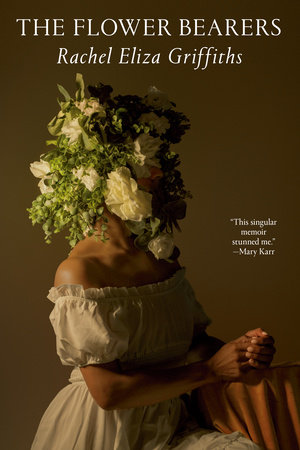
“This singular memoir stunned me. With a poet’s precision, Rachel Eliza Griffiths renders two interwoven tragedies few others could have lived through, much less written about with such clear-eyed candor.”—Mary Karr, New York Times bestselling author of The Liars’ Club

On September 24, 2021, Rachel Eliza Griffiths married her husband, the novelist Salman Rushdie. On the same day, hundreds of miles away, Griffiths’ closest friend and chosen sister, the poet Kamilah Aisha Moon, who was expected to speak at the wedding, died suddenly. Eleven months later, as Griffiths attempted to piece together her life as a newlywed with heartbreak in one hand and immense love in the other, a brutal attack nearly killed her husband. As trauma compounded trauma, Griffiths realized that in order to survive her grief, she would need to mourn not only her friend, but the woman she had been on her wedding day, a woman who had also died that day.

In the process of rebuilding a self, Griffiths chronicles her friendship with Moon, the seventeen years since their meeting at Sarah Lawrence College. Together, they embraced their literary foremothers—Lucille Clifton, Toni Morrison, Alice Walker, to name a few—and fought to embrace themselves as poets, artists, and Black women. Alongside this unbreakable bond, Griffiths weaves the story of her relationship with Rushdie, of the challenges they have faced and the unshakeable devotion that endures.

In The Flower Bearers, Griffiths inscribes the trajectories of two transformational relationships with grace and honesty, chronicling the beauty and pain that comes with opening oneself fully to love.
1

The hands do not belong to me.

Lying on the hotel bed in the sun-­drenched light of a late-­September morning, I hold them up for study, turning them in slow circles. Brown and slender, long arms stretch above their parallel shadows on the white sheet. Tapered fingers, imprinted in darkening script, bend and extend, as if casting a spell. From the fingertips to the forearms, each arm is sheathed in rich henna. The wrists, palms, and knuckles are embroidered with a hand-­drawn world of diamonds and delicate curlicues. On my left palm, a man’s name has been inscribed so subtly, I have to look closely to see it at all.

Along the routes of these two palms exist hundreds of lifelines that were, at some point, mine. The hands I examine are suddenly unfamiliar, separate from the knowledge and memories that have lived in me for over forty years.

What have these hands done? What have they made? What have they ruined? Who loves them?

The hotel room, a corner suite with two tall shimmering windows, comes into view. It’s the kind of light that makes me feel that something is going to happen.

My hands resemble my mother’s, but I never saw my mother with hennaed hands or feet. The familiar image of our hands and feet cannot merge as easily as they often do in me. A woman sees both more and less of her mother as time passes, as she begins to comprehend her own body, her own story.

My mother has been dead nearly ten years, but the memory of her fills my days and mirrors. When I want to speak to her, I only need to face a mirror. I still hear her distinct voice and can remember the shape of her lips when she formed them to pronounce the name she gave me at birth.

For the past two years, my hands have been living a story which my mother can neither judge nor advise. She favored heart-­sense, an austere blend of common sense and courage, above all things.

My mother worked hard, too hard, using her hands each day to cut, slice, chop, fold, and knead the world into a reality that did not demand her defeat. Idle hands disgusted her. Filthy hands belonged to Satan. My mother spoke about the right hand of God the Father, where Jesus sat. She never mentioned the left.

Since her death, I’ve often looked at my own hands, searching for their inheritance. My hands work hard too, but not in the ways that would have gained my mother’s approval.

I have no children. I do not do my own laundry. I do not braid or cornrow my own hair. I do not open the hoods of cars or change tires like women who know such things. I rarely set the table properly. I let my nails grow too long. Though I keep trying with piano, I play no instruments with natural ease. I do not fish (allergies and the horror of hooks). I do not hunt. I do not use a knife to carve wood or to chop onions.

I have no green thumb though the natural world fills me with special pleasure. In that kindred wilderness, I touch leaves, bark, stones, snails, skulls, insects, flowers, bones, and rushing cold water.

I write. I hold a camera. I draw and paint. I’ve turned the pages of thousands of books. I’ve pulled a suitcase across hundreds of cities. I’ve shaken hands with countless strangers, hoping their hands are clean enough. I’ve made spectacular ice cream cones and sundaes for my nephew and niece, saddened that my mother will never meet them. I’ve petted no less than one thousand and one dogs’ ears.

Today, my inked hands would’ve made my mother roll her eyes. I imagine her pencil-­thin brows lifting incredulously at the sight of the fragrant ink looping my wrists with dark color. Her voice quips: Are you doing this again? She is asking about love.

Despite and beyond death, some mothers and daughters go back and forth this way. The elder tosses out a question that is less question than judgment. It may be posed as a question only to indicate that the daughter should have anti­cipated the mother’s response. In this instance, the daughter—­me—­sometimes still needs her mother’s posthumous opinion even as she—­I—­protests that she is old enough to write and to live her own stories.

Are you doing this again?

Yes! I am in love—­again!

The hotel suite thrums with my pasts.

I am an artist. I am a child. I am a daughter. I am the eldest of four children. I am a big sister. I am a teacher and a student. A beginning—­I am a shiny, cellular fleck spun in 1978, December, half past midnight.

I am a tree and the ocean. I am a mountain, a glacier. I am a sage and a fool.

The first time I married was next to the Caribbean Sea. It was a safe love. Comfortable, age-appropriate, a formal settling-­in after many years of living together, I had been inside of a love that did not require me to live beyond the shallows. My depths I kept concealed and reserved for myself. I hid in the safety of codependency, even as I lived inside a lucid inner life.

The models of marriage around me mostly reflected the things that made me fearful—­losing or sacrificing myself and my dreams for someone else. I never had any intention of allowing anyone to ever really know me. Perhaps I knew the theoretical definition of marriage, and then there were the married couples I’d observed in real life, but the reality of marriage never touched me. I didn’t even really know him, which seemed fair, since I couldn’t let him know me. Being wed to each other was something we were just supposed to do, because of time passing. There was real love between us, but neither of us could ever admit, until it was finished, that we were incompatible and immature.

I hadn’t comprehended that my own lack of self-­love was the primary culprit in the marriage’s end.

But today I’m marrying again. I’m a forty-­two-­year-­old bride. By noon, I’ll be a wife again. How many miles exist between those two words, bride and wife? Or groom and husband? An event happens. A wedding. Two beings, ordinary as hands on the face of a clock, orbit love, and love orbits them. Wherever they converge, those mismatched arrows clinging to each other, is both predictable and unpredictable. Often those hands share time without ever touching. In the ways that love changes time itself, those hands change from minute to hour to year.

Pushing away the duvet, I perch on the edge of the bed. My fingers grip the luxury sheet. I encounter every texture as a sharp sensation that brings tears to my eyes. I remember the black silk negligee dress I wore to the darkened, candle-­lit restaurant where Salman first told me he loved me. We were sitting in a crescent-­shaped booth with deep red upholstery beneath a mural of mostly dead writers, painted as caricatures. A nude, swooning Anaïs Nin reclined just above us. I remember the air rushing across the blades of my exposed shoulders as the words were whispered against my collarbone. And how I slid the silk away from my skin later that night, wanting to be exposed and immersed in the name of a love that was as marvelous as the love of words and life itself we both shared.

I want to grasp the life that has led me to this, the morning of my second wedding. There won’t be another one. I want to think about who I have been, to the best of my knowledge. I’ll never have this morning’s happiness in the exact same way again.

Two days ago, a laughing Indian woman used a tightly packed tube of henna, rolling it precisely between her fingertips, to etch an imagined cosmology onto my body. When she finished, she gave me careful instructions about applying her lemon-­sugar poultice to make sure the henna soaked into the deepest layer of my skin. This mixture, she assured me, would help extend the length of time my skin would hold the design.

When the woman discovered who my fiancé was, through an unrelenting series of not-­so-innocent questions about the Indian wedding she realized we weren’t having, she immediately texted her parents in New Jersey to disclose that I was going to be the fifth wife of Sir Salman Rushdie.

“Is he here at home with you now?”

“Yes, probably watching Law & Order in the other room.”

“Could I please have a photo with him? For my parents, of course, to see that I am telling the truth. They say it is not possible.”

I called for Salman to come to the kitchen where I sat, holding my hands and arms out like a scarecrow. My feet were raised and hung over a small stool. Introducing the henna artist to him, I asked whether he was willing to take a photo. After inspecting the henna and inquiring where the young woman’s family originated in India, he said, “Of course.”

Hours later, I’d walked around in my robe, watching bits of dried henna flake from my hands and feet. It stained my towels and anything I used to prevent the design from smearing. Avoiding the oatmeal-­colored furniture of the house we were staying in, I called out to Salman for help. He’d been surprised when I announced I was getting traditional wedding henna for our ceremony, but his eyes sparkled as he gazed at my feet and palms.

“God, I love you,” he said as he helped me wrap my feet in cling wrap. “It’s very good, the real kind.”
The Flower Bearers is a memoir of duality, of intoxicating love and excruciating loss. Here is a poet plying her tools in the service of literature’s most vital work: describing life and how to bear it.”—Geraldine Brooks, author of Memorial Days

“In prose as luminous as her verse, Rachel Eliza Griffiths has written a testament to the human spirit’s ability to withstand a sundering—and to emerge with a heart made wider by the breaking.”—Suleika Jaouad, author of Between Two Kingdoms

“With the sensitivity of an artist and the intimacy of a faithful friend, Griffiths offers us a searing reminder that to live is to insist on love, relentlessly.”—Qian Julie Wang, author of Beautiful Country

“This powerful memoir sings at the intersection of female friendship, eldest daughterhood, ravaging grief, surprise romance, and the Black poetry scene.”—Quiara Alegría Hudes, author of My Broken Language

“Every page of this book reads like an offering, reminding us how we all endure—and can even bloom—through the beauty and the breaking.”—Isaac Fitzgerald, author of Dirtbag, Massachusetts

“Monumental, profound, and gorgeous, The Flower Bearers is a dazzling hat-tip to our iconic literary ancestors—Lorde, Baldwin, Morrison—and poetic tribute to a new one: Moon.”—MK Asante, author of Buck: A Memoir

“Unsparing and full-throated . . . Griffiths’s call to bear witness to and make sense of the gut-wrenching pain of loss is at its core an exploration of capacity, resilience, and the deeply human need to remain open to love in all its forms.”—A. M. Homes, author of The Mistress’s Daughter

“Rachel Eliza Griffiths has knitted together, from grief, rage, and love, a remarkable memoir: searching and tender and filled with something like grace.”—Christina Sharpe, author of Ordinary Notes

“This profoundly felt account moves between the raw, the lyrical, and the elegiac as it seeks the light of healing.”Kirkus Reviews, starred review

“In this astounding memoir, Griffiths offers a death-defying loop of triumphant love across life’s infernal torments. This is no mere book but a generational blooming.”—Canisia Lubrin, author of The Dyzgraphxst

“A beautiful and immensely powerful book about love, grief, and finding a way to be in a forever-altered world.”—Julia Samuel, Sunday Times bestselling author of Grief Works: Stories of Life, Death, and Surviving
© Rachel Eliza Griffiths
Rachel Eliza Griffiths is a poet, visual artist, and novelist. She is a recipient of the Hurston/Wright Foundation Legacy Award and the Paterson Poetry Prize and was a finalist for a NAACP Image Award. Griffiths is also a recipient of fellowships from many organizations, including Cave Canem Foundation, Kimbilio, the Provincetown Fine Arts Work Center, the Robert Rauschenberg Foundation, and Yaddo. Her work has been published in The New York Times, The New Yorker, Tin House, and other publications. Her debut novel, Promise, was a Kirkus Reviews and Chicago Public Library Best Book of the Year. View titles by Rachel Eliza Griffiths

About

“This singular memoir stunned me. With a poet’s precision, Rachel Eliza Griffiths renders two interwoven tragedies few others could have lived through, much less written about with such clear-eyed candor.”—Mary Karr, New York Times bestselling author of The Liars’ Club

On September 24, 2021, Rachel Eliza Griffiths married her husband, the novelist Salman Rushdie. On the same day, hundreds of miles away, Griffiths’ closest friend and chosen sister, the poet Kamilah Aisha Moon, who was expected to speak at the wedding, died suddenly. Eleven months later, as Griffiths attempted to piece together her life as a newlywed with heartbreak in one hand and immense love in the other, a brutal attack nearly killed her husband. As trauma compounded trauma, Griffiths realized that in order to survive her grief, she would need to mourn not only her friend, but the woman she had been on her wedding day, a woman who had also died that day.

In the process of rebuilding a self, Griffiths chronicles her friendship with Moon, the seventeen years since their meeting at Sarah Lawrence College. Together, they embraced their literary foremothers—Lucille Clifton, Toni Morrison, Alice Walker, to name a few—and fought to embrace themselves as poets, artists, and Black women. Alongside this unbreakable bond, Griffiths weaves the story of her relationship with Rushdie, of the challenges they have faced and the unshakeable devotion that endures.

In The Flower Bearers, Griffiths inscribes the trajectories of two transformational relationships with grace and honesty, chronicling the beauty and pain that comes with opening oneself fully to love.

Excerpt

1

The hands do not belong to me.

Lying on the hotel bed in the sun-­drenched light of a late-­September morning, I hold them up for study, turning them in slow circles. Brown and slender, long arms stretch above their parallel shadows on the white sheet. Tapered fingers, imprinted in darkening script, bend and extend, as if casting a spell. From the fingertips to the forearms, each arm is sheathed in rich henna. The wrists, palms, and knuckles are embroidered with a hand-­drawn world of diamonds and delicate curlicues. On my left palm, a man’s name has been inscribed so subtly, I have to look closely to see it at all.

Along the routes of these two palms exist hundreds of lifelines that were, at some point, mine. The hands I examine are suddenly unfamiliar, separate from the knowledge and memories that have lived in me for over forty years.

What have these hands done? What have they made? What have they ruined? Who loves them?

The hotel room, a corner suite with two tall shimmering windows, comes into view. It’s the kind of light that makes me feel that something is going to happen.

My hands resemble my mother’s, but I never saw my mother with hennaed hands or feet. The familiar image of our hands and feet cannot merge as easily as they often do in me. A woman sees both more and less of her mother as time passes, as she begins to comprehend her own body, her own story.

My mother has been dead nearly ten years, but the memory of her fills my days and mirrors. When I want to speak to her, I only need to face a mirror. I still hear her distinct voice and can remember the shape of her lips when she formed them to pronounce the name she gave me at birth.

For the past two years, my hands have been living a story which my mother can neither judge nor advise. She favored heart-­sense, an austere blend of common sense and courage, above all things.

My mother worked hard, too hard, using her hands each day to cut, slice, chop, fold, and knead the world into a reality that did not demand her defeat. Idle hands disgusted her. Filthy hands belonged to Satan. My mother spoke about the right hand of God the Father, where Jesus sat. She never mentioned the left.

Since her death, I’ve often looked at my own hands, searching for their inheritance. My hands work hard too, but not in the ways that would have gained my mother’s approval.

I have no children. I do not do my own laundry. I do not braid or cornrow my own hair. I do not open the hoods of cars or change tires like women who know such things. I rarely set the table properly. I let my nails grow too long. Though I keep trying with piano, I play no instruments with natural ease. I do not fish (allergies and the horror of hooks). I do not hunt. I do not use a knife to carve wood or to chop onions.

I have no green thumb though the natural world fills me with special pleasure. In that kindred wilderness, I touch leaves, bark, stones, snails, skulls, insects, flowers, bones, and rushing cold water.

I write. I hold a camera. I draw and paint. I’ve turned the pages of thousands of books. I’ve pulled a suitcase across hundreds of cities. I’ve shaken hands with countless strangers, hoping their hands are clean enough. I’ve made spectacular ice cream cones and sundaes for my nephew and niece, saddened that my mother will never meet them. I’ve petted no less than one thousand and one dogs’ ears.

Today, my inked hands would’ve made my mother roll her eyes. I imagine her pencil-­thin brows lifting incredulously at the sight of the fragrant ink looping my wrists with dark color. Her voice quips: Are you doing this again? She is asking about love.

Despite and beyond death, some mothers and daughters go back and forth this way. The elder tosses out a question that is less question than judgment. It may be posed as a question only to indicate that the daughter should have anti­cipated the mother’s response. In this instance, the daughter—­me—­sometimes still needs her mother’s posthumous opinion even as she—­I—­protests that she is old enough to write and to live her own stories.

Are you doing this again?

Yes! I am in love—­again!

The hotel suite thrums with my pasts.

I am an artist. I am a child. I am a daughter. I am the eldest of four children. I am a big sister. I am a teacher and a student. A beginning—­I am a shiny, cellular fleck spun in 1978, December, half past midnight.

I am a tree and the ocean. I am a mountain, a glacier. I am a sage and a fool.

The first time I married was next to the Caribbean Sea. It was a safe love. Comfortable, age-appropriate, a formal settling-­in after many years of living together, I had been inside of a love that did not require me to live beyond the shallows. My depths I kept concealed and reserved for myself. I hid in the safety of codependency, even as I lived inside a lucid inner life.

The models of marriage around me mostly reflected the things that made me fearful—­losing or sacrificing myself and my dreams for someone else. I never had any intention of allowing anyone to ever really know me. Perhaps I knew the theoretical definition of marriage, and then there were the married couples I’d observed in real life, but the reality of marriage never touched me. I didn’t even really know him, which seemed fair, since I couldn’t let him know me. Being wed to each other was something we were just supposed to do, because of time passing. There was real love between us, but neither of us could ever admit, until it was finished, that we were incompatible and immature.

I hadn’t comprehended that my own lack of self-­love was the primary culprit in the marriage’s end.

But today I’m marrying again. I’m a forty-­two-­year-­old bride. By noon, I’ll be a wife again. How many miles exist between those two words, bride and wife? Or groom and husband? An event happens. A wedding. Two beings, ordinary as hands on the face of a clock, orbit love, and love orbits them. Wherever they converge, those mismatched arrows clinging to each other, is both predictable and unpredictable. Often those hands share time without ever touching. In the ways that love changes time itself, those hands change from minute to hour to year.

Pushing away the duvet, I perch on the edge of the bed. My fingers grip the luxury sheet. I encounter every texture as a sharp sensation that brings tears to my eyes. I remember the black silk negligee dress I wore to the darkened, candle-­lit restaurant where Salman first told me he loved me. We were sitting in a crescent-­shaped booth with deep red upholstery beneath a mural of mostly dead writers, painted as caricatures. A nude, swooning Anaïs Nin reclined just above us. I remember the air rushing across the blades of my exposed shoulders as the words were whispered against my collarbone. And how I slid the silk away from my skin later that night, wanting to be exposed and immersed in the name of a love that was as marvelous as the love of words and life itself we both shared.

I want to grasp the life that has led me to this, the morning of my second wedding. There won’t be another one. I want to think about who I have been, to the best of my knowledge. I’ll never have this morning’s happiness in the exact same way again.

Two days ago, a laughing Indian woman used a tightly packed tube of henna, rolling it precisely between her fingertips, to etch an imagined cosmology onto my body. When she finished, she gave me careful instructions about applying her lemon-­sugar poultice to make sure the henna soaked into the deepest layer of my skin. This mixture, she assured me, would help extend the length of time my skin would hold the design.

When the woman discovered who my fiancé was, through an unrelenting series of not-­so-innocent questions about the Indian wedding she realized we weren’t having, she immediately texted her parents in New Jersey to disclose that I was going to be the fifth wife of Sir Salman Rushdie.

“Is he here at home with you now?”

“Yes, probably watching Law & Order in the other room.”

“Could I please have a photo with him? For my parents, of course, to see that I am telling the truth. They say it is not possible.”

I called for Salman to come to the kitchen where I sat, holding my hands and arms out like a scarecrow. My feet were raised and hung over a small stool. Introducing the henna artist to him, I asked whether he was willing to take a photo. After inspecting the henna and inquiring where the young woman’s family originated in India, he said, “Of course.”

Hours later, I’d walked around in my robe, watching bits of dried henna flake from my hands and feet. It stained my towels and anything I used to prevent the design from smearing. Avoiding the oatmeal-­colored furniture of the house we were staying in, I called out to Salman for help. He’d been surprised when I announced I was getting traditional wedding henna for our ceremony, but his eyes sparkled as he gazed at my feet and palms.

“God, I love you,” he said as he helped me wrap my feet in cling wrap. “It’s very good, the real kind.”

Praise

The Flower Bearers is a memoir of duality, of intoxicating love and excruciating loss. Here is a poet plying her tools in the service of literature’s most vital work: describing life and how to bear it.”—Geraldine Brooks, author of Memorial Days

“In prose as luminous as her verse, Rachel Eliza Griffiths has written a testament to the human spirit’s ability to withstand a sundering—and to emerge with a heart made wider by the breaking.”—Suleika Jaouad, author of Between Two Kingdoms

“With the sensitivity of an artist and the intimacy of a faithful friend, Griffiths offers us a searing reminder that to live is to insist on love, relentlessly.”—Qian Julie Wang, author of Beautiful Country

“This powerful memoir sings at the intersection of female friendship, eldest daughterhood, ravaging grief, surprise romance, and the Black poetry scene.”—Quiara Alegría Hudes, author of My Broken Language

“Every page of this book reads like an offering, reminding us how we all endure—and can even bloom—through the beauty and the breaking.”—Isaac Fitzgerald, author of Dirtbag, Massachusetts

“Monumental, profound, and gorgeous, The Flower Bearers is a dazzling hat-tip to our iconic literary ancestors—Lorde, Baldwin, Morrison—and poetic tribute to a new one: Moon.”—MK Asante, author of Buck: A Memoir

“Unsparing and full-throated . . . Griffiths’s call to bear witness to and make sense of the gut-wrenching pain of loss is at its core an exploration of capacity, resilience, and the deeply human need to remain open to love in all its forms.”—A. M. Homes, author of The Mistress’s Daughter

“Rachel Eliza Griffiths has knitted together, from grief, rage, and love, a remarkable memoir: searching and tender and filled with something like grace.”—Christina Sharpe, author of Ordinary Notes

“This profoundly felt account moves between the raw, the lyrical, and the elegiac as it seeks the light of healing.”Kirkus Reviews, starred review

“In this astounding memoir, Griffiths offers a death-defying loop of triumphant love across life’s infernal torments. This is no mere book but a generational blooming.”—Canisia Lubrin, author of The Dyzgraphxst

“A beautiful and immensely powerful book about love, grief, and finding a way to be in a forever-altered world.”—Julia Samuel, Sunday Times bestselling author of Grief Works: Stories of Life, Death, and Surviving

Author

© Rachel Eliza Griffiths
Rachel Eliza Griffiths is a poet, visual artist, and novelist. She is a recipient of the Hurston/Wright Foundation Legacy Award and the Paterson Poetry Prize and was a finalist for a NAACP Image Award. Griffiths is also a recipient of fellowships from many organizations, including Cave Canem Foundation, Kimbilio, the Provincetown Fine Arts Work Center, the Robert Rauschenberg Foundation, and Yaddo. Her work has been published in The New York Times, The New Yorker, Tin House, and other publications. Her debut novel, Promise, was a Kirkus Reviews and Chicago Public Library Best Book of the Year. View titles by Rachel Eliza Griffiths

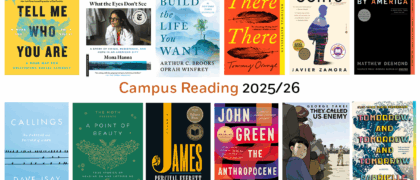
What Students Will Be Reading: Campus Common Reading Roundup, 2025-26

With the fall semester in full swing, colleges and universities around the country have announced their Common Reading books for the upcoming 2025-26 academic year. We’ve compiled a list of over 286 programs and their title selections from publicly available sources, which you can download here: First-Year Reading 2025-26. We will continue to update this

Read more

Register for the 2026 Penguin Random House First-Year Experience® Conference Author Events!

Penguin Random House Author Events at the 45th Annual First-Year Experience® Conference February 15-18, 2026 Seattle, Washington Hyatt Regency Seattle Click Here to RSVP A complimentary meal and a limited number of books will be available to attendees. Each event will also be followed by an author signing. Interested in hosting one of these authors at

Read more

2026 Catalog for First-Year & Common Reading

We are delighted to present our new First-Year & Common Reading Catalog for 2026! From award-winning fiction, poetry, memoir, and biography to new books about the environment, current events, history, public health, science, social justice, student success, and technology, the titles presented in our common reading catalog will have students not only eagerly flipping through

Read more