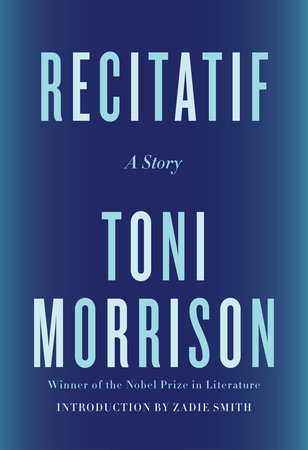
A beautiful, arresting story about race and the relationships that shape us through life by the legendary Nobel Prize winner—for the first time in a beautifully produced stand-alone edition, with an introduction by Zadie Smith

In this 1983 short story—the only short story Morrison ever wrote—we meet Twyla and Roberta, who have known each other since they were eight years old and spent four months together as roommates in St. Bonaventure shelter. Inseparable then, they lose touch as they grow older, only later to find each other again at a diner, a grocery store, and again at a protest. Seemingly at opposite ends of every problem, and at each other's throats each time they meet, the two women still cannot deny the deep bond their shared experience has forged between them.
 
Another work of genius by this masterly writer, “Recitatif” keeps Twyla's and Roberta's races ambiguous throughout the story. Morrison herself described “Recitatif,” a story which will keep readers thinking and discussing for years to come, as "an experiment in the removal of all racial codes from a narrative about two characters of different races for whom racial identity is crucial." We know that one is white and one is Black, but which is which? And who is right about the race of the woman the girls tormented at the orphanage?
 
A remarkable look into what keeps us together and what keeps us apart, and how perceptions are made tangible by reality, “Recitatif” is a gift to readers in these changing times.


Selected for Common Reading at the following colleges and universities:

Miami Dade College - Hialeah Campus
University of California, Santa Cruz - Porter College
Chapter 1

My mother danced all night and Roberta’s was sick. That’s why we were taken to St. Bonny’s. People want to put their arms around you when you tell them you were in a shelter, but it really wasn’t bad. No big long room with one hundred beds like Bellevue. There were four to a room, and when Roberta and me came, there was a shortage of state kids, so we were the only ones assigned to 406 and could go from bed to bed if we wanted to. And we wanted to, too. We changed beds every night and for the whole four months we were there we never picked one out as our own permanent bed.

It didn’t start out that way. The minute I walked in and the Big Bozo introduced us, I got sick to my stomach. It was one thing to be taken out of your own bed early in the morning—it was something else to be stuck in a strange place with a girl from a whole other race. And Mary, that’s my mother, she was right. Every now and then she would stop dancing long enough to tell me something important and one of the things she said was that they never washed their hair and they smelled funny. Roberta sure did. Smell funny, I mean. So when the Big Bozo (nobody ever called her Mrs. Itkin, just like nobody ever said St. Bonaventure)—when she said, “Twyla, this is Roberta. Roberta, this is Twyla. Make each other welcome,” I said, “My mother won’t like you putting me in here.”

“Good,” said Bozo. “Maybe then she’ll come and take you home.”

How’s that for mean? If Roberta had laughed I would have killed her, but she didn’t. She just walked over to the window and stood with her back to us.

“Turn around,” said the Bozo. “Don’t be rude. Now Twyla. Roberta. When you hear a loud buzzer, that’s the call for dinner. Come down to the first floor. Any fights and no movie.” And then, just to make sure we knew what we would be missing, “The Wizard of Oz.”

Roberta must have thought I meant that my mother would be mad about my being put in the shelter. Not about rooming with her, because as soon as Bozo left she came over to me and said, “Is your mother sick too?”

“No,” I said. “She just likes to dance all night.”

“Oh.” She nodded her head and I liked the way she understood things so fast. So for the moment it didn’t matter that we looked like salt and pepper standing there and that’s what the other kids called us sometimes. We were eight years old and got F’s all the time. Me because I couldn’t remember what I read or what the teacher said. And Roberta because she couldn’t read at all and didn’t even listen to the teacher. She wasn’t good at anything except jacks, at which she was a killer: pow scoop pow scoop pow scoop.

We didn’t like each other all that much at first, but nobody else wanted to play with us because we weren’t real orphans with beautiful dead parents in the sky. We were dumped. Even the New York City Puerto Ricans and the upstate Indians ignored us. All kinds of kids were in there, black ones, white ones, even two Koreans. The food was good, though. At least I thought so. Roberta hated it and left whole pieces of things on her plate: Spam, Salisbury steak—even Jell-O with fruit cocktail in it—and she didn’t care if I ate what she wouldn’t. Mary’s idea of supper was popcorn and a can of Yoo-hoo. Hot mashed potatoes and two weenies was like Thanksgiving for me.

It really wasn’t bad, St. Bonny’s. The big girls on the second floor pushed us around now and then. But that was all. They wore lipstick and eyebrow pencil and wobbled their knees while they watched TV. Fifteen, sixteen, even, some of them were. They were put-out girls, scared runaways most of them. Poor little girls who fought their uncles off but looked tough to us, and mean. God did they look mean. The staff tried to keep them separate from the younger children, but sometimes they caught us watching them in the orchard where they played radios and danced with each other. They’d light out after us and pull our hair or twist our arms. We were scared of them, Roberta and me, but neither of us wanted the other one to know it. So we got a good list of dirty names we could shout back when we ran from them through the orchard. I used to dream a lot and almost always the orchard was there. Two acres, four maybe, of these little apple trees. Hundreds of them. Empty and crooked like beggar women when I first came to St. Bonny’s but fat with flowers when I left. I don’t know why I dreamt about that orchard so much. Nothing really happened there. Nothing all that important, I mean. Just the big girls dancing and playing the radio. Roberta and me watching. Maggie fell down there once. The kitchen woman with legs like parentheses. And the big girls laughed at her. We should have helped her up, I know, but we were scared of those girls with lipstick and eyebrow pencil. Maggie couldn’t talk. The kids said she had her tongue cut out, but I think she was just born that way: mute. She was old and sandy colored and she worked in the kitchen. I don’t know if she was nice or not. I just remember her legs like parentheses and how she rocked when she walked. She worked from early in the morning till two o’clock, and if she was late, if she had too much cleaning and didn’t get out till two fifteen or so, she’d cut through the orchard so she wouldn’t miss her bus and have to wait another hour. She wore this really stupid little hat—a kid’s hat with earflaps—and she wasn’t much taller than we were. A really awful little hat. Even for a mute, it was dumb—dressing like a kid and never saying anything at all.

“But what about if somebody tries to kill her?” I used to wonder about that. “Or what if she wants to cry? Can she cry?”

“Sure,” Roberta said. “But just tears. No sounds come out.”

“She can’t scream?”

“Nope. Nothing.”

“Can she hear?”

“I guess.”

“Let’s call her,” I said. And we did.

“Dummy! Dummy!” She never turned her head.

“Bow legs! Bow legs!” Nothing. She just rocked on, the chin straps of her baby-boy hat swaying from side to side. I think we were wrong. I think she could hear and didn’t let on. And it shames me even now to think there was somebody in there after all who heard us call her those names and couldn’t tell on us.

We got along all right, Roberta and me. Changed beds every night, got F’s in civics and communication skills and gym. The Bozo was disappointed in us, she said. Out of 130 of us state cases, 90 were under twelve. Almost all were real orphans with beautiful dead parents in the sky. We were the only ones dumped and the only ones with F’s in three classes including gym. So we got along—what with her leaving whole pieces of things on her plate and being nice about not asking questions.

I think it was the day before Maggie fell down that we found out our mothers were coming to visit us on the same Sunday. We had been at the shelter twenty-eight days (Roberta twenty-eight and a half) and this was their first visit with us. Our mothers would come at ten o’clock, in time for chapel, then lunch with us in the teachers’ lounge. I thought if my dancing mother met her sick mother it might be good for her. And Roberta thought her sick mother would get a big bang out of a dancing one. We got excited about it and curled each other’s hair. After breakfast we sat on the bed watching the road from the window. Roberta’s socks were still wet. She washed them the night before and put them on the radiator to dry. They hadn’t, but she put them on anyway because their tops were so pretty scalloped in pink. Each of us had a purple construction-paper basket that we had made in craft class. Mine had a yellow crayon rabbit on it. Roberta’s had eggs with wiggly lines of color. Inside were cellophane grass and just the jelly beans because I’d eaten the two marshmallow eggs they gave us. The Big Bozo came herself to get us. Smiling she told us we looked very nice and to come downstairs. We were so surprised by the smile we’d never seen before, neither of us moved.

“Don’t you want to see your mommies?”

I stood up first and spilled the jelly beans all over the floor. Bozo’s smile disappeared while we scrambled to get the candy up off the floor and put it back in the grass.

She escorted us downstairs to the first floor, where the other girls were lining up to file into the chapel. A bunch of grown-ups stood to one side. Viewers mostly. The old biddies who wanted servants and the fags who wanted company looking for children they might want to adopt. Once in a while a grandmother. Almost never anybody young or anybody whose face wouldn’t scare you in the night. Because if any of the real orphans had young relatives they wouldn’t be real orphans. I saw Mary right away. She had on those green slacks I hated and hated even more now because didn’t she know we were going to chapel? And that fur jacket with the pocket linings so ripped she had to pull to get her hands out of them. But her face was pretty—like always, and she smiled and waved like she was the little girl looking for her mother—not me.

I walked slowly, trying not to drop the jelly beans and hoping the paper handle would hold. I had to use my last Chiclet because by the time I finished cutting everything out, all the Elmer’s was gone. I am left-handed and the scissors never worked for me. It didn’t matter, though; I might just as well have chewed the gum. Mary dropped to her knees and grabbed me, mashing the basket, the jelly beans, and the grass into her ratty fur jacket.

“Twyla, baby. Twyla, baby!”

I could have killed her. Already I heard the big girls in the orchard the next time saying, “Twyyyyyla, baby!” But I couldn’t stay mad at Mary while she was smiling and hugging me and smelling of Lady Esther dusting powder. I wanted to stay buried in her fur all day.

To tell the truth I forgot about Roberta. Mary and I got in line for the traipse into chapel and I was feeling proud because she looked so beautiful even in those ugly green slacks that made her behind stick out. A pretty mother on earth is better than a beautiful dead one in the sky even if she did leave you all alone to go dancing.

I felt a tap on my shoulder, turned, and saw Roberta smiling. I smiled back, but not too much lest somebody think this visit was the biggest thing that ever happened in my life. Then Roberta said, “Mother, I want you to meet my roommate, Twyla. And that’s Twyla’s mother.”

I looked up it seemed for miles. She was big. Bigger than any man and on her chest was the biggest cross I’d ever seen. I swear it was six inches long each way. And in the crook of her arm was the biggest Bible ever made.

Mary, simpleminded as ever, grinned and tried to yank her hand out of the pocket with the raggedy lining—to shake hands, I guess. Roberta’s mother looked down at me and then looked down at Mary too. She didn’t say anything, just grabbed Roberta with her Bible-free hand and stepped out of line, walking quickly to the rear of it. Mary was still grinning because she’s not too swift when it comes to what’s really going on. Then this light bulb goes off in her head and she says, “That bitch!” really loud and us almost in the chapel now. Organ music whining; the Bonny Angels singing sweetly. Everybody in the world turned around to look. And Mary would have kept it up—kept calling names if I hadn’t squeezed her hand as hard as I could. That helped a little, but she still twitched and crossed and uncrossed her legs all through service. Even groaned a couple of times. Why did I think she would come there and act right? Slacks. No hat like the grandmothers and viewers, and groaning all the while. When we stood for hymns she kept her mouth shut. Wouldn’t even look at the words on the page. She actually reached in her purse for a mirror to check her lipstick. All I could think of was that she really needed to be killed. The sermon lasted a year, and I knew the real orphans were looking smug again.

We were supposed to have lunch in the teachers’ lounge, but Mary didn’t bring anything, so we picked fur and cellophane grass off the mashed jelly beans and ate them. I could have killed her. I sneaked a look at Roberta. Her mother had brought chicken legs and ham sandwiches and oranges and a whole box of chocolate-covered grahams. Roberta drank milk from a thermos while her mother read the Bible to her.

Things are not right. The wrong food is always with the wrong people. Maybe that’s why I got into waitress work later—to match up the right people with the right food. Roberta just let those chicken legs sit there, but she did bring a stack of grahams up to me later when the visit was over. I think she was sorry that her mother would not shake my mother’s hand. And I liked that and I liked the fact that she didn’t say a word about Mary groaning all the way through the service and not bringing any lunch.

Roberta left in May when the apple trees were heavy and white. On her last day we went to the orchard to watch the big girls smoke and dance by the radio. It didn’t matter that they said, “Twyyyyyla, baby.” We sat on the ground and breathed. Lady Esther. Apple blossoms. I still go soft when I smell one or the other. Roberta was going home. The big cross and the big Bible was coming to get her and she seemed sort of glad and sort of not. I thought I would die in that room of four beds without her and I knew Bozo had plans to move some other dumped kid in there with me. Roberta promised to write every day, which was really sweet of her because she couldn’t read a lick so how could she write anybody. I would have drawn pictures and sent them to her but she never gave me her address. Little by little she faded. Her wet socks with the pink scalloped tops and her big serious-looking eyes—that’s all I could catch when I tried to bring her to mind.
  • AWARD | 1993
    Nobel Prize in Literature
An NPR Best Book of the Year

“‘Recitatif’ . . .  is ambitious, pointed, and surprisingly playful when it comes to race. Morrison described it as ‘an experiment in the removal of all racial codes from a narrative about two characters of different races for whom racial identity is crucial’. . . . So shrewd and economical is Morrison’s storytelling, so tightly controlled is her experiment. ‘Recitatif’ is brilliant and worthy of space in your brain and bookshelf.” 
—The Philadelphia Inquirer
 
“Nobel laureate Morrison’s only short story, originally published in 1983 and now as a slender, elegant volume enhanced by Smith’s insightful introduction, is a knockout. . . . In her captivating story, Morrison ingeniously leads readers to challenge racial stereotypes and consider nuanced power dynamics with questions that linger beyond the last page.” 
—The National Book Review
 
“When I return to ‘Recitatif,’ it is with a renewed understanding that, along with a handful of other African Americans, Morrison was among the first to depict Black culture while also considering politics, while also considering United States history, while also considering white supremacy, while also considering economic class, while also considering gender, while also considering intergenerational trauma. As the kids might say, Toni Morrison did that.”
—Honorée Fanonne Jeffers, New York Times Book Review

“Strikingly relevant. . . . We can never tell definitively which woman is White and which is Black. It shouldn’t matter, but it does. The story constantly tempts us to test our racial attitudes about clothing, food, hair, even money. . . . This is the perfect text for a country still vigorously debating the relevance of race. But the singular quality of this story makes it worthwhile, especially because the book contains a long, thoughtful introduction by Zadie Smith, who says, rightly, that ‘Recitatif’ should sit alongside ‘Bartleby, the Scrivener’ and ‘The Lottery’ ‘as a perfect—and perfectly American—tale’. . . . Smith’s illuminating discussion . . . provides a close reading and examines the way racial categories function in our allegedly post-racial culture.” 
—Ron Charles, Washington Post

“Page for page, it is as powerful and audacious an exploration of racial bias in America as her 11 novels. . . . profoundly thought-provoking. Even four decades after this story was written, readers are ineluctably drawn into a quandary about which character is white and which is Black. But here’s the brilliance of Morrison’s experiment: Each conjecture exposes the reader’s own racial preconceptions. . . . ‘Recitatif’ is a shrewd feat of composition and social commentary. . . . Its short length would make it an ideal, accessible selection for book groups and community-wide reading programs, sure to spark self-scrutiny and discussion. Both timely and timeless, it’s a story I can’t recommend highly enough.” 
—Heller McAlpin, Christian Science Monitor
 
“Toni Morrison spoke often about the incoherence of race. . . . While maintaining that there is no such thing as race, the acclaimed writer and Nobel laureate explored extensively through her work how living in a society structured around this artificial category shaped the lives of her characters. Those very ideas are at the heart of ‘Recitatif’. The story is a puzzle of sorts, as Smith writes in the introduction, because Morrison never explicitly reveals the racial identity of either character. . . . Morrison challenges the reader's impulse to neatly categorize people and forces them to consider other markers: disability, gender, class. . . . Though ‘Recitatif’ was written decades earlier, the themes it deals with and the questions it poses, remain relevant as ever.” 
—CNN.com
 
“To much of the world the late Toni Morrison was a novelist, celebrated for such classics as Beloved, Song of Solomon and The Bluest Eye. But the Nobel laureate did not confine herself to one kind of writing. . . . In her introduction, Smith likens ‘Recitatif’ to a puzzle or a game, while warning that ‘Toni Morrison does not play.’ Throughout the story, Morrison will refer to everything from hair length to social status as if to challenge the reader’s own racial assumptions.” 
—AP News
 
“Morrison’s only published short story is reissued here with an illuminating foreword by Zadie Smith. . . . Like much of Morrison’s work, this story is a deceptively simple and intricate indictment of the ludicrousness of racism.” 
—Buzzfeed, “26 Books to Get Excited About This Year”
 
“Morrison’s sharp-eyed treatment of race, racism, and racial hierarchies remains relevant, digging deep into the marrow of society’s maladies.” 
—Literary Hub, “Most Anticipated Books of 2022”
 
“[‘Recitatif’] stands resoundingly on its own. . . . Endlessly ponderable. In her substantial and enlightening introduction, Zadie Smith quotes Morrison, whom she describes as ‘the great master of American complexity,’ explaining that this tale is ‘an experiment in the removal of all racial codes.’ This is a profound and foundation-rocking conundrum of a story.” 
—Booklist
 
“[A] stunning work. . . . An illuminating introduction. . . .[Morrison’s] experiment pays off brilliantly, forcing the reader to consider racial stereotypes while also providing an indelible story. The gravitas and unparalleled skill found in Morrison’s best-known work is on full display in this compact powerhouse.”
—Publishers Weekly (starred review)
 
“A thought experiment, illuminated here by Smith's close analysis of equal length. . . . On every page, Morrison teases said reader with details about the girls, their mothers, and their lots in life that seem like they could help solve the puzzle of which is Black and which is White, yet they never conclusively do so. And as the story is designed to show and Smith will make sure you see, that is not the most important thing. . . . A uniquely interesting and enlightening reading experience.” 
—Kirkus Reviews (starred review)
TONI MORRISON is the author of eleven novels and three essay collections. She received the National Book Critics Circle Award, the Pulitzer Prize, and in 1993 the Nobel Prize in Literature. She died in 2019. View titles by Toni Morrison

About

A beautiful, arresting story about race and the relationships that shape us through life by the legendary Nobel Prize winner—for the first time in a beautifully produced stand-alone edition, with an introduction by Zadie Smith

In this 1983 short story—the only short story Morrison ever wrote—we meet Twyla and Roberta, who have known each other since they were eight years old and spent four months together as roommates in St. Bonaventure shelter. Inseparable then, they lose touch as they grow older, only later to find each other again at a diner, a grocery store, and again at a protest. Seemingly at opposite ends of every problem, and at each other's throats each time they meet, the two women still cannot deny the deep bond their shared experience has forged between them.
 
Another work of genius by this masterly writer, “Recitatif” keeps Twyla's and Roberta's races ambiguous throughout the story. Morrison herself described “Recitatif,” a story which will keep readers thinking and discussing for years to come, as "an experiment in the removal of all racial codes from a narrative about two characters of different races for whom racial identity is crucial." We know that one is white and one is Black, but which is which? And who is right about the race of the woman the girls tormented at the orphanage?
 
A remarkable look into what keeps us together and what keeps us apart, and how perceptions are made tangible by reality, “Recitatif” is a gift to readers in these changing times.


Selected for Common Reading at the following colleges and universities:

Miami Dade College - Hialeah Campus
University of California, Santa Cruz - Porter College

Excerpt

Chapter 1

My mother danced all night and Roberta’s was sick. That’s why we were taken to St. Bonny’s. People want to put their arms around you when you tell them you were in a shelter, but it really wasn’t bad. No big long room with one hundred beds like Bellevue. There were four to a room, and when Roberta and me came, there was a shortage of state kids, so we were the only ones assigned to 406 and could go from bed to bed if we wanted to. And we wanted to, too. We changed beds every night and for the whole four months we were there we never picked one out as our own permanent bed.

It didn’t start out that way. The minute I walked in and the Big Bozo introduced us, I got sick to my stomach. It was one thing to be taken out of your own bed early in the morning—it was something else to be stuck in a strange place with a girl from a whole other race. And Mary, that’s my mother, she was right. Every now and then she would stop dancing long enough to tell me something important and one of the things she said was that they never washed their hair and they smelled funny. Roberta sure did. Smell funny, I mean. So when the Big Bozo (nobody ever called her Mrs. Itkin, just like nobody ever said St. Bonaventure)—when she said, “Twyla, this is Roberta. Roberta, this is Twyla. Make each other welcome,” I said, “My mother won’t like you putting me in here.”

“Good,” said Bozo. “Maybe then she’ll come and take you home.”

How’s that for mean? If Roberta had laughed I would have killed her, but she didn’t. She just walked over to the window and stood with her back to us.

“Turn around,” said the Bozo. “Don’t be rude. Now Twyla. Roberta. When you hear a loud buzzer, that’s the call for dinner. Come down to the first floor. Any fights and no movie.” And then, just to make sure we knew what we would be missing, “The Wizard of Oz.”

Roberta must have thought I meant that my mother would be mad about my being put in the shelter. Not about rooming with her, because as soon as Bozo left she came over to me and said, “Is your mother sick too?”

“No,” I said. “She just likes to dance all night.”

“Oh.” She nodded her head and I liked the way she understood things so fast. So for the moment it didn’t matter that we looked like salt and pepper standing there and that’s what the other kids called us sometimes. We were eight years old and got F’s all the time. Me because I couldn’t remember what I read or what the teacher said. And Roberta because she couldn’t read at all and didn’t even listen to the teacher. She wasn’t good at anything except jacks, at which she was a killer: pow scoop pow scoop pow scoop.

We didn’t like each other all that much at first, but nobody else wanted to play with us because we weren’t real orphans with beautiful dead parents in the sky. We were dumped. Even the New York City Puerto Ricans and the upstate Indians ignored us. All kinds of kids were in there, black ones, white ones, even two Koreans. The food was good, though. At least I thought so. Roberta hated it and left whole pieces of things on her plate: Spam, Salisbury steak—even Jell-O with fruit cocktail in it—and she didn’t care if I ate what she wouldn’t. Mary’s idea of supper was popcorn and a can of Yoo-hoo. Hot mashed potatoes and two weenies was like Thanksgiving for me.

It really wasn’t bad, St. Bonny’s. The big girls on the second floor pushed us around now and then. But that was all. They wore lipstick and eyebrow pencil and wobbled their knees while they watched TV. Fifteen, sixteen, even, some of them were. They were put-out girls, scared runaways most of them. Poor little girls who fought their uncles off but looked tough to us, and mean. God did they look mean. The staff tried to keep them separate from the younger children, but sometimes they caught us watching them in the orchard where they played radios and danced with each other. They’d light out after us and pull our hair or twist our arms. We were scared of them, Roberta and me, but neither of us wanted the other one to know it. So we got a good list of dirty names we could shout back when we ran from them through the orchard. I used to dream a lot and almost always the orchard was there. Two acres, four maybe, of these little apple trees. Hundreds of them. Empty and crooked like beggar women when I first came to St. Bonny’s but fat with flowers when I left. I don’t know why I dreamt about that orchard so much. Nothing really happened there. Nothing all that important, I mean. Just the big girls dancing and playing the radio. Roberta and me watching. Maggie fell down there once. The kitchen woman with legs like parentheses. And the big girls laughed at her. We should have helped her up, I know, but we were scared of those girls with lipstick and eyebrow pencil. Maggie couldn’t talk. The kids said she had her tongue cut out, but I think she was just born that way: mute. She was old and sandy colored and she worked in the kitchen. I don’t know if she was nice or not. I just remember her legs like parentheses and how she rocked when she walked. She worked from early in the morning till two o’clock, and if she was late, if she had too much cleaning and didn’t get out till two fifteen or so, she’d cut through the orchard so she wouldn’t miss her bus and have to wait another hour. She wore this really stupid little hat—a kid’s hat with earflaps—and she wasn’t much taller than we were. A really awful little hat. Even for a mute, it was dumb—dressing like a kid and never saying anything at all.

“But what about if somebody tries to kill her?” I used to wonder about that. “Or what if she wants to cry? Can she cry?”

“Sure,” Roberta said. “But just tears. No sounds come out.”

“She can’t scream?”

“Nope. Nothing.”

“Can she hear?”

“I guess.”

“Let’s call her,” I said. And we did.

“Dummy! Dummy!” She never turned her head.

“Bow legs! Bow legs!” Nothing. She just rocked on, the chin straps of her baby-boy hat swaying from side to side. I think we were wrong. I think she could hear and didn’t let on. And it shames me even now to think there was somebody in there after all who heard us call her those names and couldn’t tell on us.

We got along all right, Roberta and me. Changed beds every night, got F’s in civics and communication skills and gym. The Bozo was disappointed in us, she said. Out of 130 of us state cases, 90 were under twelve. Almost all were real orphans with beautiful dead parents in the sky. We were the only ones dumped and the only ones with F’s in three classes including gym. So we got along—what with her leaving whole pieces of things on her plate and being nice about not asking questions.

I think it was the day before Maggie fell down that we found out our mothers were coming to visit us on the same Sunday. We had been at the shelter twenty-eight days (Roberta twenty-eight and a half) and this was their first visit with us. Our mothers would come at ten o’clock, in time for chapel, then lunch with us in the teachers’ lounge. I thought if my dancing mother met her sick mother it might be good for her. And Roberta thought her sick mother would get a big bang out of a dancing one. We got excited about it and curled each other’s hair. After breakfast we sat on the bed watching the road from the window. Roberta’s socks were still wet. She washed them the night before and put them on the radiator to dry. They hadn’t, but she put them on anyway because their tops were so pretty scalloped in pink. Each of us had a purple construction-paper basket that we had made in craft class. Mine had a yellow crayon rabbit on it. Roberta’s had eggs with wiggly lines of color. Inside were cellophane grass and just the jelly beans because I’d eaten the two marshmallow eggs they gave us. The Big Bozo came herself to get us. Smiling she told us we looked very nice and to come downstairs. We were so surprised by the smile we’d never seen before, neither of us moved.

“Don’t you want to see your mommies?”

I stood up first and spilled the jelly beans all over the floor. Bozo’s smile disappeared while we scrambled to get the candy up off the floor and put it back in the grass.

She escorted us downstairs to the first floor, where the other girls were lining up to file into the chapel. A bunch of grown-ups stood to one side. Viewers mostly. The old biddies who wanted servants and the fags who wanted company looking for children they might want to adopt. Once in a while a grandmother. Almost never anybody young or anybody whose face wouldn’t scare you in the night. Because if any of the real orphans had young relatives they wouldn’t be real orphans. I saw Mary right away. She had on those green slacks I hated and hated even more now because didn’t she know we were going to chapel? And that fur jacket with the pocket linings so ripped she had to pull to get her hands out of them. But her face was pretty—like always, and she smiled and waved like she was the little girl looking for her mother—not me.

I walked slowly, trying not to drop the jelly beans and hoping the paper handle would hold. I had to use my last Chiclet because by the time I finished cutting everything out, all the Elmer’s was gone. I am left-handed and the scissors never worked for me. It didn’t matter, though; I might just as well have chewed the gum. Mary dropped to her knees and grabbed me, mashing the basket, the jelly beans, and the grass into her ratty fur jacket.

“Twyla, baby. Twyla, baby!”

I could have killed her. Already I heard the big girls in the orchard the next time saying, “Twyyyyyla, baby!” But I couldn’t stay mad at Mary while she was smiling and hugging me and smelling of Lady Esther dusting powder. I wanted to stay buried in her fur all day.

To tell the truth I forgot about Roberta. Mary and I got in line for the traipse into chapel and I was feeling proud because she looked so beautiful even in those ugly green slacks that made her behind stick out. A pretty mother on earth is better than a beautiful dead one in the sky even if she did leave you all alone to go dancing.

I felt a tap on my shoulder, turned, and saw Roberta smiling. I smiled back, but not too much lest somebody think this visit was the biggest thing that ever happened in my life. Then Roberta said, “Mother, I want you to meet my roommate, Twyla. And that’s Twyla’s mother.”

I looked up it seemed for miles. She was big. Bigger than any man and on her chest was the biggest cross I’d ever seen. I swear it was six inches long each way. And in the crook of her arm was the biggest Bible ever made.

Mary, simpleminded as ever, grinned and tried to yank her hand out of the pocket with the raggedy lining—to shake hands, I guess. Roberta’s mother looked down at me and then looked down at Mary too. She didn’t say anything, just grabbed Roberta with her Bible-free hand and stepped out of line, walking quickly to the rear of it. Mary was still grinning because she’s not too swift when it comes to what’s really going on. Then this light bulb goes off in her head and she says, “That bitch!” really loud and us almost in the chapel now. Organ music whining; the Bonny Angels singing sweetly. Everybody in the world turned around to look. And Mary would have kept it up—kept calling names if I hadn’t squeezed her hand as hard as I could. That helped a little, but she still twitched and crossed and uncrossed her legs all through service. Even groaned a couple of times. Why did I think she would come there and act right? Slacks. No hat like the grandmothers and viewers, and groaning all the while. When we stood for hymns she kept her mouth shut. Wouldn’t even look at the words on the page. She actually reached in her purse for a mirror to check her lipstick. All I could think of was that she really needed to be killed. The sermon lasted a year, and I knew the real orphans were looking smug again.

We were supposed to have lunch in the teachers’ lounge, but Mary didn’t bring anything, so we picked fur and cellophane grass off the mashed jelly beans and ate them. I could have killed her. I sneaked a look at Roberta. Her mother had brought chicken legs and ham sandwiches and oranges and a whole box of chocolate-covered grahams. Roberta drank milk from a thermos while her mother read the Bible to her.

Things are not right. The wrong food is always with the wrong people. Maybe that’s why I got into waitress work later—to match up the right people with the right food. Roberta just let those chicken legs sit there, but she did bring a stack of grahams up to me later when the visit was over. I think she was sorry that her mother would not shake my mother’s hand. And I liked that and I liked the fact that she didn’t say a word about Mary groaning all the way through the service and not bringing any lunch.

Roberta left in May when the apple trees were heavy and white. On her last day we went to the orchard to watch the big girls smoke and dance by the radio. It didn’t matter that they said, “Twyyyyyla, baby.” We sat on the ground and breathed. Lady Esther. Apple blossoms. I still go soft when I smell one or the other. Roberta was going home. The big cross and the big Bible was coming to get her and she seemed sort of glad and sort of not. I thought I would die in that room of four beds without her and I knew Bozo had plans to move some other dumped kid in there with me. Roberta promised to write every day, which was really sweet of her because she couldn’t read a lick so how could she write anybody. I would have drawn pictures and sent them to her but she never gave me her address. Little by little she faded. Her wet socks with the pink scalloped tops and her big serious-looking eyes—that’s all I could catch when I tried to bring her to mind.

Awards

  • AWARD | 1993
    Nobel Prize in Literature

Praise

An NPR Best Book of the Year

“‘Recitatif’ . . .  is ambitious, pointed, and surprisingly playful when it comes to race. Morrison described it as ‘an experiment in the removal of all racial codes from a narrative about two characters of different races for whom racial identity is crucial’. . . . So shrewd and economical is Morrison’s storytelling, so tightly controlled is her experiment. ‘Recitatif’ is brilliant and worthy of space in your brain and bookshelf.” 
—The Philadelphia Inquirer
 
“Nobel laureate Morrison’s only short story, originally published in 1983 and now as a slender, elegant volume enhanced by Smith’s insightful introduction, is a knockout. . . . In her captivating story, Morrison ingeniously leads readers to challenge racial stereotypes and consider nuanced power dynamics with questions that linger beyond the last page.” 
—The National Book Review
 
“When I return to ‘Recitatif,’ it is with a renewed understanding that, along with a handful of other African Americans, Morrison was among the first to depict Black culture while also considering politics, while also considering United States history, while also considering white supremacy, while also considering economic class, while also considering gender, while also considering intergenerational trauma. As the kids might say, Toni Morrison did that.”
—Honorée Fanonne Jeffers, New York Times Book Review

“Strikingly relevant. . . . We can never tell definitively which woman is White and which is Black. It shouldn’t matter, but it does. The story constantly tempts us to test our racial attitudes about clothing, food, hair, even money. . . . This is the perfect text for a country still vigorously debating the relevance of race. But the singular quality of this story makes it worthwhile, especially because the book contains a long, thoughtful introduction by Zadie Smith, who says, rightly, that ‘Recitatif’ should sit alongside ‘Bartleby, the Scrivener’ and ‘The Lottery’ ‘as a perfect—and perfectly American—tale’. . . . Smith’s illuminating discussion . . . provides a close reading and examines the way racial categories function in our allegedly post-racial culture.” 
—Ron Charles, Washington Post

“Page for page, it is as powerful and audacious an exploration of racial bias in America as her 11 novels. . . . profoundly thought-provoking. Even four decades after this story was written, readers are ineluctably drawn into a quandary about which character is white and which is Black. But here’s the brilliance of Morrison’s experiment: Each conjecture exposes the reader’s own racial preconceptions. . . . ‘Recitatif’ is a shrewd feat of composition and social commentary. . . . Its short length would make it an ideal, accessible selection for book groups and community-wide reading programs, sure to spark self-scrutiny and discussion. Both timely and timeless, it’s a story I can’t recommend highly enough.” 
—Heller McAlpin, Christian Science Monitor
 
“Toni Morrison spoke often about the incoherence of race. . . . While maintaining that there is no such thing as race, the acclaimed writer and Nobel laureate explored extensively through her work how living in a society structured around this artificial category shaped the lives of her characters. Those very ideas are at the heart of ‘Recitatif’. The story is a puzzle of sorts, as Smith writes in the introduction, because Morrison never explicitly reveals the racial identity of either character. . . . Morrison challenges the reader's impulse to neatly categorize people and forces them to consider other markers: disability, gender, class. . . . Though ‘Recitatif’ was written decades earlier, the themes it deals with and the questions it poses, remain relevant as ever.” 
—CNN.com
 
“To much of the world the late Toni Morrison was a novelist, celebrated for such classics as Beloved, Song of Solomon and The Bluest Eye. But the Nobel laureate did not confine herself to one kind of writing. . . . In her introduction, Smith likens ‘Recitatif’ to a puzzle or a game, while warning that ‘Toni Morrison does not play.’ Throughout the story, Morrison will refer to everything from hair length to social status as if to challenge the reader’s own racial assumptions.” 
—AP News
 
“Morrison’s only published short story is reissued here with an illuminating foreword by Zadie Smith. . . . Like much of Morrison’s work, this story is a deceptively simple and intricate indictment of the ludicrousness of racism.” 
—Buzzfeed, “26 Books to Get Excited About This Year”
 
“Morrison’s sharp-eyed treatment of race, racism, and racial hierarchies remains relevant, digging deep into the marrow of society’s maladies.” 
—Literary Hub, “Most Anticipated Books of 2022”
 
“[‘Recitatif’] stands resoundingly on its own. . . . Endlessly ponderable. In her substantial and enlightening introduction, Zadie Smith quotes Morrison, whom she describes as ‘the great master of American complexity,’ explaining that this tale is ‘an experiment in the removal of all racial codes.’ This is a profound and foundation-rocking conundrum of a story.” 
—Booklist
 
“[A] stunning work. . . . An illuminating introduction. . . .[Morrison’s] experiment pays off brilliantly, forcing the reader to consider racial stereotypes while also providing an indelible story. The gravitas and unparalleled skill found in Morrison’s best-known work is on full display in this compact powerhouse.”
—Publishers Weekly (starred review)
 
“A thought experiment, illuminated here by Smith's close analysis of equal length. . . . On every page, Morrison teases said reader with details about the girls, their mothers, and their lots in life that seem like they could help solve the puzzle of which is Black and which is White, yet they never conclusively do so. And as the story is designed to show and Smith will make sure you see, that is not the most important thing. . . . A uniquely interesting and enlightening reading experience.” 
—Kirkus Reviews (starred review)

Author

TONI MORRISON is the author of eleven novels and three essay collections. She received the National Book Critics Circle Award, the Pulitzer Prize, and in 1993 the Nobel Prize in Literature. She died in 2019. View titles by Toni Morrison

What Students Will Be Reading: Campus Common Reading Roundup, 2026–27

With the fall semester in full swing, colleges and universities across the country have announced their Common Reading books for the 2026–27 academic year. We’ve compiled a list of over 250 programs and their title selections, detailed below. We will continue to update this listing to provide the most comprehensive record of programs available anywhere

Read more

2027 Catalog for First-Year & Common Reading

We are delighted to present our new First-Year & Common Reading Catalog for 2027! From award-winning fiction, poetry, memoir, and biography to new books about the environment, current events, history, public health, science, social justice, student success, and technology, the titles presented in our common reading catalog will have students not only eagerly flipping through

Read more

Videos from the 2026 First-Year Experience® Conference are now available

We’re pleased to share videos from the 2026 First-Year Experience® Conference. Whether you weren’t able to join us at the conference or would simply like to hear the talks again, please take a moment to view the clips below.   Penguin Random House Author Breakfast Monday, February 17th, 7:15 – 8:45 am PST   This

Read more