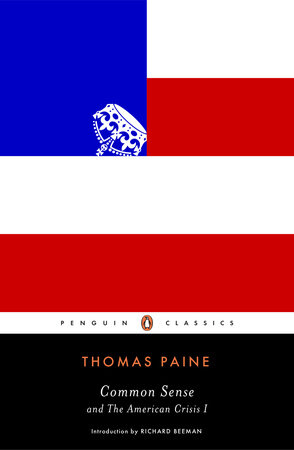
Common Sense

and The American Crisis I

Introduction by Richard Beeman
Look inside
The writings that inspired the American Revolution—in an expanded new edition

Thomas Paine’s Common Sense may well be the most influential polemic in all of American history. Published anonymously in 1776, six months before the Declaration of Independence, this incendiary call for Americans to revolt against British rule converted millions to the cause of independence and set out a vision of a just society liberated from the yoke of the crown. Paine’s pamphlet was the first to speak directly to a mass audience—and his assertive and often caustic style embodied the democratic spirit he advocated.

This expanded edition also features Paine’s The American Crisis I, the first in a series of pamphlets aimed at bolstering American morale during the Revolution. An introduction by preeminent constitutional expert Richard Beeman traces Paine’s origins and illuminates the significance of these writings.

For more than sixty-five years, Penguin has been the leading publisher of classic literature in the English-speaking world. With more than 1,500 titles, Penguin Classics represents a global bookshelf of the best works throughout history and across genres and disciplines. Readers trust the series to provide authoritative texts enhanced by introductions and notes by distinguished scholars and contemporary authors, as well as up-to-date translations by award-winning translators.
Of the Origin and Design of Government in General. With Concise Remarks on the English Constitution

Some writers have so confounded society with government, as to leave little or no distinction between them; whereas they are not only different, but have different origins. Society is produced by our wants, and government by our wickedness; the former promotes our happiness positively by uniting our affections, the latter negatively by restraining our vices. The one encourages intercourse, the other creates distinctions. The first is a patron, the last a punisher.

Society in every state is a blessing, but government even in its best state is but a necessary evil; in its worst state an intolerable one; for when we suffer, or are exposed to the same miseries by a government, which we might expect in a country without government, our calamities are heightened by reflecting that we furnish the means by which we suffer. Government, like dress, is the badge of lost innocence; the palaces of kings are built on the ruins of the bowers of paradise. For were the impulses of conscience clear, uniform, and irresistibly obeyed, man would need no other lawgiver; but that not being the case, he finds it necessary to surrender up a part of his property to furnish means for the protection of the rest; and this he is induced to do by the same prudence which in every other case advises him out of two evils to choose the least.

“No writer has exceeded Paine in ease and familiarity of style; in perspicuity of expression, happiness of elucidation, and in simple unassuming language.” —Thomas Jefferson
Thomas Paine was born in Thetford, England, in 1737, the son of a staymaker. He had little schooling and worked at a number of jobs, including tax collector, a position he lost for agitating for an increase in excisemen’s pay. Persuaded by Benjamin Franklin, he emigrated to America in 1774. In 1776 he began his American Crisis series of thirteen pamphlets, and also published the incalculably influential Common Sense, which established Paine not only as a truly revolutionary thinker, but as the American Revolution’s fiercest political theorist. In 1787 Paine returned to Europe, where he became involved in revolutionary politics. In England his books were burned by the public hangman. Escaping to France, Paine took part in drafting the French constitution and voted against the king’s execution. He was imprisoned for a year and narrowly missed execution himself. In 1802 he returned to America and lived in New York State, poor, ill and largely despised for his extremism and so-called atheism (he was in fact a deist). Thomas Paine died in 1809. His body was exhumed by William Cobbett, and the remains were taken to England for a memorial burial. Unfortunately, the remains were subsequently lost. View titles by Thomas Paine

About

The writings that inspired the American Revolution—in an expanded new edition

Thomas Paine’s Common Sense may well be the most influential polemic in all of American history. Published anonymously in 1776, six months before the Declaration of Independence, this incendiary call for Americans to revolt against British rule converted millions to the cause of independence and set out a vision of a just society liberated from the yoke of the crown. Paine’s pamphlet was the first to speak directly to a mass audience—and his assertive and often caustic style embodied the democratic spirit he advocated.

This expanded edition also features Paine’s The American Crisis I, the first in a series of pamphlets aimed at bolstering American morale during the Revolution. An introduction by preeminent constitutional expert Richard Beeman traces Paine’s origins and illuminates the significance of these writings.

For more than sixty-five years, Penguin has been the leading publisher of classic literature in the English-speaking world. With more than 1,500 titles, Penguin Classics represents a global bookshelf of the best works throughout history and across genres and disciplines. Readers trust the series to provide authoritative texts enhanced by introductions and notes by distinguished scholars and contemporary authors, as well as up-to-date translations by award-winning translators.

Excerpt

Of the Origin and Design of Government in General. With Concise Remarks on the English Constitution

Some writers have so confounded society with government, as to leave little or no distinction between them; whereas they are not only different, but have different origins. Society is produced by our wants, and government by our wickedness; the former promotes our happiness positively by uniting our affections, the latter negatively by restraining our vices. The one encourages intercourse, the other creates distinctions. The first is a patron, the last a punisher.

Society in every state is a blessing, but government even in its best state is but a necessary evil; in its worst state an intolerable one; for when we suffer, or are exposed to the same miseries by a government, which we might expect in a country without government, our calamities are heightened by reflecting that we furnish the means by which we suffer. Government, like dress, is the badge of lost innocence; the palaces of kings are built on the ruins of the bowers of paradise. For were the impulses of conscience clear, uniform, and irresistibly obeyed, man would need no other lawgiver; but that not being the case, he finds it necessary to surrender up a part of his property to furnish means for the protection of the rest; and this he is induced to do by the same prudence which in every other case advises him out of two evils to choose the least.

Praise

“No writer has exceeded Paine in ease and familiarity of style; in perspicuity of expression, happiness of elucidation, and in simple unassuming language.” —Thomas Jefferson

Author

Thomas Paine was born in Thetford, England, in 1737, the son of a staymaker. He had little schooling and worked at a number of jobs, including tax collector, a position he lost for agitating for an increase in excisemen’s pay. Persuaded by Benjamin Franklin, he emigrated to America in 1774. In 1776 he began his American Crisis series of thirteen pamphlets, and also published the incalculably influential Common Sense, which established Paine not only as a truly revolutionary thinker, but as the American Revolution’s fiercest political theorist. In 1787 Paine returned to Europe, where he became involved in revolutionary politics. In England his books were burned by the public hangman. Escaping to France, Paine took part in drafting the French constitution and voted against the king’s execution. He was imprisoned for a year and narrowly missed execution himself. In 1802 he returned to America and lived in New York State, poor, ill and largely despised for his extremism and so-called atheism (he was in fact a deist). Thomas Paine died in 1809. His body was exhumed by William Cobbett, and the remains were taken to England for a memorial burial. Unfortunately, the remains were subsequently lost. View titles by Thomas Paine

What Students Will Be Reading: Campus Common Reading Roundup, 2026–27

With the fall semester in full swing, colleges and universities across the country have announced their Common Reading books for the 2026–27 academic year. We’ve compiled a list of over 250 programs and their title selections, detailed below. We will continue to update this listing to provide the most comprehensive record of programs available anywhere

Read more

2027 Catalog for First-Year & Common Reading

We are delighted to present our new First-Year & Common Reading Catalog for 2027! From award-winning fiction, poetry, memoir, and biography to new books about the environment, current events, history, public health, science, social justice, student success, and technology, the titles presented in our common reading catalog will have students not only eagerly flipping through

Read more

Videos from the 2026 First-Year Experience® Conference are now available

We’re pleased to share videos from the 2026 First-Year Experience® Conference. Whether you weren’t able to join us at the conference or would simply like to hear the talks again, please take a moment to view the clips below.   Penguin Random House Author Breakfast Monday, February 17th, 7:15 – 8:45 am PST   This

Read more