Download high-resolution image Look inside
Listen to a clip from the audiobook
audio pause button
0:00
0:00

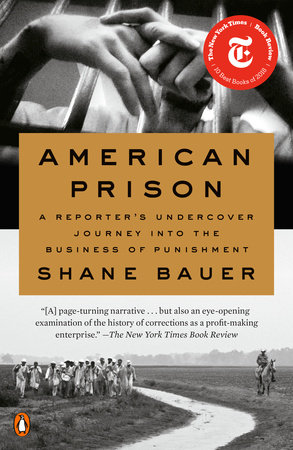
American Prison

A Reporter's Undercover Journey into the Business of Punishment

Look inside
Listen to a clip from the audiobook
audio pause button
0:00
0:00
An enraging, necessary look at the private prison system, and a convincing clarion call for prison reform.” —NPR.org

New York Times Book Review
 10 Best Books of 2018 * One of President Barack Obama’s favorite books of 2018 * 
Winner of the 2019 J. Anthony Lukas Book Prize * Winner of the Helen Bernstein Book Award for Excellence in Journalism * Winner of the 2019 RFK Book and Journalism Award * A New York Times Notable Book 

A ground-breaking and brave inside reckoning with the nexus of prison and profit in America: in one Louisiana prison and over the course of our country's history.


In 2014, Shane Bauer was hired for $9 an hour to work as an entry-level prison guard at a private prison in Winnfield, Louisiana. An award-winning investigative journalist, he used his real name; there was no meaningful background check. Four months later, his employment came to an abrupt end. But he had seen enough, and in short order he wrote an exposé about his experiences that won a National Magazine Award and became the most-read feature in the history of the magazine Mother Jones. Still, there was much more that he needed to say. In American Prison, Bauer weaves a much deeper reckoning with his experiences together with a thoroughly researched history of for-profit prisons in America from their origins in the decades before the Civil War. For, as he soon realized, we can't understand the cruelty of our current system and its place in the larger story of mass incarceration without understanding where it came from. Private prisons became entrenched in the South as part of a systemic effort to keep the African-American labor force in place in the aftermath of slavery, and the echoes of these shameful origins are with us still.

The private prison system is deliberately unaccountable to public scrutiny. Private prisons are not incentivized to tend to the health of their inmates, or to feed them well, or to attract and retain a highly-trained prison staff. Though Bauer befriends some of his colleagues and sympathizes with their plight, the chronic dysfunction of their lives only adds to the prison's sense of chaos. To his horror, Bauer finds himself becoming crueler and more aggressive the longer he works in the prison, and he is far from alone.

A blistering indictment of the private prison system, and the powerful forces that drive it, American Prison is a necessary human document about the true face of justice in America.
1

Two weeks after accepting the job, in November 2014, having grown a goatee, pulled the plugs from my earlobes, and bought a beat-up Dodge Ram pickup, I pull into Winnfield, a town of approximately forty-six hundred people three hours north of Baton Rouge. If you happened to drive through it, it's the kind of place you'd only remember because some lonesome image stuck in your mind: a street of collapsed wooden houses, empty except for a tethered dog and a gaunt white woman carrying a laundry basket on her hip; the former Mexican restaurant that serves daiquiris in Styrofoam cups to drivers as they come home from work; a stack of local newspapers with headlines about a Civil War general; a black lady picking pennies up off of the pavement outside the gas station. About 38 percent of households here live below the poverty line; the median household income is $25,000. Residents are proud of the fact that three governors came from Winnfield before 1940, including agrarian populist Huey Long. They are less proud that the last sheriff was locked up for dealing meth.

Winn Correctional Center is thirteen miles from town, set in the middle of the Kisatchie National Forest, a more than six hundred thousand-acre expanse of southern yellow pines crosshatched with dirt roads. As I drive through the thick forest on December 1, 2014, the prison emerges from the fog-a dull expanse of bland concrete buildings and corrugated metal sheds. One could mistake it for an oddly placed factory were it not so well branded. On the side of the road is the kind of large sign one finds in suburban business parks, displaying CCA's corporate logo, with the negative space of the letter A shaped like the head of a screeching bald eagle.

At the entrance, a guard who looks about sixty, with a gun on her hip, asks me to turn off my truck, open the doors, and step out. A tall, stern-faced white man leads a German shepherd into the cab. My heart hammers. There is camera equipment lying on the seat. I tell the woman I am a new cadet, here to begin my four weeks of training. She directs me to a building just outside the prison fence.

Have a good one, baby, she says as I pull through the gate. I exhale.

I park and sit in my truck. In the front seat of a nearby car, a guard checks her makeup in her visor mirror. A family sits in a four-door sedan, probably waiting to visit a loved one, legs dangling idly out of open doors. In front of me two tall chain-link fences surround the prison, razor wire spooled out along the top. A cat walks slowly across a large, empty expanse of pavement inside. A metallic church steeple pokes above the buildings. The pine forest surrounds the compound, thick and tall.

I get out and walk across the lot, my mind focused on the guard towers, where I imagine officers are watching me. The prison's HR director told me last week that Lane Blair, one of the company's managing directors, had called to ask about me. She said it was very unusual that corporate would take an interest in a particular cadet. Since then, I have been certain that the company's higher-ups know who I am. When I enter the classroom, no one is there. The longer I sit, the more I am convinced it is a trap. What will happen if they come for me?

Another cadet enters, sits next to me, and introduces himself. He's nineteen years old, black, and just out of high school. His name is Reynolds.

You nervous? he asks.

A little, I say. You?

Nah, I been around, he says. I seen killin'. My uncle killed three people. My brother been in jail and my cousin. I ain't nervous. He says he just needs a job for a while until he begins college in a few months. He has a baby to feed. He also wants to put speakers in his new truck. They told him he could work on his days off, so he'll probably come in every day. That will be a fat paycheck, he says. He puts his head down and falls asleep.

Four more students trickle in, and then the HR director. She scolds Reynolds for napping, and he perks up when she tells us that if we recruit a friend to work here, we'll get five hundred bucks. She gives us a random assortment of other tips: Don't eat the food given to inmates; don't have sex with the inmates or you could be fined $10,000 or get sentenced to "ten years at hard labor"; try not to get sick, because we don't get paid sick time. If we have friends or relatives incarcerated here, we need to report it. She hands out magnets to put on our fridges with a hotline to call in case we become suicidal or begin fighting with our families. We get three counseling sessions for free.

I studiously jot down notes as the HR director fires up a video of the company's CEO, who tells us in a corporate-promotional tone what a great opportunity it is to be a corrections officer at CCA. He is our shining light, an example of a man who climbed all the way up the ladder. (In 2018 he makes $4 million a year, twenty times the salary of the director of the Federal Bureau of Prisons.) You may be brand-new to CCA, but we need you, he says. We need your enthusiasm. We need your bright ideas. During the academy, I felt camaraderie. I felt a little anxiety too. That is completely normal. The other thing I felt was tremendous excitement.

I look around the room. Not one person-not the high school graduate, not the former Walmart manager, not the nurse, not the single mom who came back after eleven years of McDonald's and a stint in the military-betrays anything resembling excitement.

I don't think this is for me, a post office worker says.

When the video stops, a thirtysomething black woman with long eyelashes and perfectly manicured fingernails stands in the front of the room. She tells us she is the head of training. Her name is Miss Blanchard. Do we know who was talking in the video? she asks.

The CEO, I say.

What was his name? she asks.

I don't know.

She looks at me like I'm an elementary school student who wasn't paying attention. Y'all are going to have to know this for the quiz at the end of the class.

Reynolds jolts his head up. There's gonna be a quiz?

His name is Damon Hininger, she says. There are also three founders. There is Thomas Beasley and T. Don Hutto. They are still with us. Then there is Dr. Crants. She slips in another VHS tape.

In the video, Hutto and Beasley tell their company's origin story. In 1983, they recount, they won "the first contract ever to design, build, finance, and operate a secure correctional facility in the world." The Immigration and Naturalization Service gave them just ninety days to do it. Hutto is frail, with a shiny white head and oversize glasses, and he smiles slightly with his hands folded in front of him. When he speaks, he gives the impression of a warm-faced grandfather who likes to repeat the "lost my thumb" trick to children. He recalls the story of obtaining their first prison contract like an old man giving a blow-by-blow accounting of his winning high school touchdown. Rushed for time, he and Beasley convinced the owner of a motel in Houston to lease it to them, eventually hiring "all his family" as staff to seal the deal. They then quickly surrounded the motel with a twelve-foot fence topped with coiled barbed wire. They left up the Day Rates Available sign. "We opened the facility on Super Bowl Sunday the end of that January," Hutto recalls. "So about ten o'clock that night we start receiving inmates. I actually took their pictures and fingerprinted them. Several other people walked them to their 'rooms,' if you will, and we got our first day's pay for eighty-seven undocumented aliens." Both men chuckle.

For Beasley, the notion of running a prison as a moneymaking enterprise was new and innovative. But for Hutto, I would discover, the idea of making money from prisoners was as old as the idea of forcing black men to pick cotton.

2

A white man on horseback, holding a rifle, looked out over an expanse of cotton that stretched beyond the horizon. Four packs of bloodhounds lay on the edge of the field. One dog had gold caps on two of his teeth, a mark of distinction for tracking a runaway and bringing him back to the plantation. Black men were lined up in squads, hunched over as they pick. The white man couldn't hear what they were singing, but he'd heard the songs before. Sometimes, as they worked, a man would sing out, "Old Master don't you whip me, I'll give you half a dollar." A group of men reply in unison, "Johnny, won't you ramble, Johnny, won't you ramble."

Old Master and old Mistress is sittin' in the parlor

Johnny, won't you ramble, Johnny, won't you ramble

Well a-figurin' out a plan to work a man harder

Johnny, won't you ramble, Johnny, won't you ramble

Old Marster told Mistress, they sittin' in the parlor

Johnny, won't you ramble, Johnny, won't you ramble

Old Marster told old Mistress to take the half a dollar

Johnny, won't you ramble, Johnny, won't you ramble

"Well I don't want his dollar, I'd rather hear him holler"

Johnny, won't you ramble, Johnny, won't you ramble

One of the men, Albert Race Sample, was picking cotton for the first time. Throughout the course of his life, he'd shined shoes, worked the circus, shot craps, and cleaned brothel rooms after prostitutes, but he had never worked in a field. His only connection to cotton was that his white father, who used to pay his black mother for sex, was a cotton broker. Sample lined up in a row with the other men in his squad, picking the bolls one by one and dropping them into the fourteen-foot sacks they dragged along. The white "bosses" assigned the fastest pickers to head each squad, making everyone else struggle to keep up. By the time Sample picked the cotton from two stalks, the rest of the row was twenty feet ahead of him. One of the bosses, known as Deadeye, walked his horse over to Sample and scrutinized his every move.

Sample grew up in his mother's brothel. As a boy, he served bootleg liquor to the men who gambled there and had sex in his bed. He would practice his dice techniques on the floor, learning how to set them in his hand and throw them in a way that would make them land just how he wanted. His mom liked to play too. Once, in the middle of a game, she told him to fetch her a roll of nickels. When he told her he lost it, she slapped him in the mouth, knocking a tooth loose, and went back to her game. Sample caught a train out of town and survived on tins of sardines, food he stole from restaurants, and picking pockets at racetracks.

Picking cotton, like picking pockets, is a skill that takes time to master. Grab too much and fingers get pricked on the boll's dried base. Grab too little and only a few strands come off. The faster Sample tried to pick, the more he dropped. The more he dropped, the more time he wasted trying to get the dirt, leaves, and stems out before putting it in his sack. "Nigger, you better go feedin' that bag and movin' them shit scratchers like you aim to do somethin'!" Deadeye shouted.

Sample's back hurt.

Eventually the bosses ordered the men to bring their sacks to the scales. The head of the squad had picked 230 pounds. One man had only picked 190 pounds, and Deadeye shouted at him. When Sample put his sack on the scale, one of the bosses, Captain Smooth, looked at Sample like he'd spit in his face. "Forty pounds!" Captain Smooth shouted. "Can you believe it? Forty fuckin' pounds of cotton!" Deadeye got a wild look in his face. "Cap'n, I'm willing to forfeit a whole month's wages if you just look the other way for five seconds so's I can throw this worthless sonofabitch away." He pointed his double-barrel shotgun, hands trembling, at Sample and laid the hammers back. Those waiting to weigh their cotton scampered away.

"Naw Boss," Captain Smooth said. "I don't believe this bastard's even worth the price of a good load of buckshot. Besides, you might splatter nigger shit all over my boots and mess up my shine." Boss Deadeye lowered his shotgun. "Where you from nigger! I suppose you one'a them city niggers that rather steal than work. Where'd you say you come from?" When Sample attempted to answer, Deadeye shouted at him. "Dry up that fuckin' ol' mouth when I'm talkin' to you!"

As punishment for his impertinence and unproductiveness, Sample would not be allowed to eat lunch or drink water for the rest of the workday. "As for you nigger, you better git your goat-smelling ass back out longer and go to picking that Godamn cotton!"

The year was 1956, nearly a century since slavery had been abolished. Sample had been convicted of robbery by assault and sentenced to thirty years in prison. In Texas, all the black convicts, and some white convicts, were forced into unpaid plantation labor, mostly in cotton fields. From the time Sample arrived and into the 1960s, sales from the plantation prisons brought the state an average of $1.7 million per year ($13 million in 2018 dollars). Nationwide, it cost states $3.50 per day to keep an inmate in prison. But in Texas it only cost about $1.50.

Like prison systems throughout the South, Texas's grew directly out of slavery. After the Civil War the state's economy was in disarray, and cotton and sugar planters suddenly found themselves without hands they could force to work. Fortunately for them, the Thirteenth Amendment, which abolished slavery, left a loophole. It said that "neither slavery nor involuntary servitude" shall exist in the United States "except as punishment for a crime." As long as black men were convicted of crimes, Texas could lease all of its prisoners to private cotton and sugar plantations and companies running lumber camps and coal mines, and building railroads. It did this for five decades after the abolition of slavery, but the state eventually became jealous of the revenue private companies and planters were earning from its prisoners. So, between 1899 and 1918, the state bought ten plantations of its own and began running them as prisons.
One of Boston Globe’s Best Books of 2018 • One of San Francisco Chronicle’s 10 Best Books of 2018 • One of Kirkus Reviews’ Best Books of 2018 • Featured in Mother Jones’ Favorite Nonfiction of 2018

American Prison reprises [Bauer’s] page-turning narrative [as reported in Mother Jones], and adds not only the fascinating back story of CCA, the nation’s first private prison company, but also an eye-opening examination of the history of corrections as a profit-making enterprise . . . Bauer is a generous narrator with a nice ear for detail, and his colleagues come across as sympathetic characters, with a few notable exceptions . . . The sheer number of forehead-slapping quotes from Bauer’s superiors and fellow guards alone are worth the price of admission.” The New York Times Book Review

American Prison is both the remarkable story of a journalist who spent four months working as a corrections officer, and a horrifying exposé of how prisoners were treated by a corporation that profited from them. . . . It’s Bauer’s investigative chops, though, that make American Prison so essential. He dedicated his time at Winn to talking with prisoners and guards, who were unaware that he was a journalist . . . Based on his first-hand experience and these conversations, he paints a damning picture of prisoner mistreatment and under-staffing at the prison, where morale among the incarcerated and the employees was poor. The stories he tells are deeply sad and consistently infuriating . . . An enraging, necessary look at the private prison system, and a convincing clarion call for prison reform.” —NPR.org

“A relentless and uncompromising book, one that takes a crowbar to the private prison industry and yanks hard, letting just enough daylight slip inside to illuminate the contours of the beast . . . The private prison industry is booming once again. To find out what that means for real people—both those who guard and those who are guarded—American Prison is the place to begin.” San Francisco Chronicle

“[Bauer] exposes the extreme inhumanity and myriad abuses perpetrated by the American prison system—problems that effect both prisoners and guards. A terrifying look into one of America’s darkest and deepest ongoing embarrassments.” —LitHub

“One of the most incisive — and damning — investigations into prison culture and business in recent memory, Bauer’s illuminating hybrid memoir and sociological study shines much-needed light into some dark corners of the criminal justice system.” Boston Globe

“Riveting . . . Bauer himself was held in an [Iranian] prison for two years, so he knows what it feels like to be on the inside, yet he brings to the text a journalist's purview and draws a direct line between American slavery, the founders of the prison corporations and the job he is hired to do. In a fascinating tightrope walk, Bauer shows that, in this so-called industry, the financial bottom line comes at a high human cost.” —Oprah.com

“The searing details of [Bauer’s] time in the Winn facility form the brutal core of his indictment: evidence of systematic cruelty and profiteering that starts to erode the morality of prisoners and guards alike.” —Vulture

“A penetrating exposé on the cruelty and mind-bending corruption of privately run prisons across the United States . . . Nearly every page of this tale contains examples of shocking inhumanity . . . A potent, necessary broadside against incarceration in the U.S.” Kirkus, starred review

“Deprivation, abuse, and fear oppress inmates and guards alike in this hard-hitting exposé of the for-profit prison industry . . . A gripping indictment of a bad business.” Publishers Weekly, starred review

“Bauer’s amazing book examines one of slavery’s toxic legacies, using convicted people to make profit . . . He observes an acutely dangerous and out-of-control environment created by CCA’s profit-driven underpaying of staff and understaffing of prisons. Bauer’s historical and journalistic work should be required reading.” Booklist

“Sometimes the only way to get the full story is to put yourself into it as an ‘immersion journalist.’ Shane Bauer wanted to know more about for-profit prisons so he got a job in one as a correction officer, or guard, and reports his experiences grippingly while weaving in the social and economic factors that give rise to these horrors. His book reveals much that that we didn’t want to know about but, having learned about, can never forget.” —Barbara Ehrenreich, author of Nickel and Dimed

American Prison is a searing, page-turning indictment of America's practice of corporate incarceration. Shane Bauer reports in the best way a journalist can: by going into a prison himself. But then he connects the dots, drawing a persuasive through-line from plantations worked by slaves, to Southern prison farms, to corporate prisons. With this braid of history and reportage Bauer reveals the criminal nature of private prisons, a world of pain that is also a business. His is a beautiful rage.” —Ted Conover, Pulitzer Prize finalist and director of the Arthur L. Carter Journalism Institute of New York University
© Ted Ely
Shane Bauer is a senior reporter for Mother Jones. He is the recipient of the National Magazine Award for Best Reporting, Harvard's Goldsmith Prize for Investigative Reporting, Atlantic Media's Michael Kelly Award, the Hillman Prize for Magazine Journalism, and at least 20 others. Bauer is the co-author, along with Sarah Shourd and Joshua Fattal, of a memoir, A Sliver of Light, which details his time spent as a prisoner in Iran. View titles by Shane Bauer

About

An enraging, necessary look at the private prison system, and a convincing clarion call for prison reform.” —NPR.org

New York Times Book Review
 10 Best Books of 2018 * One of President Barack Obama’s favorite books of 2018 * 
Winner of the 2019 J. Anthony Lukas Book Prize * Winner of the Helen Bernstein Book Award for Excellence in Journalism * Winner of the 2019 RFK Book and Journalism Award * A New York Times Notable Book 

A ground-breaking and brave inside reckoning with the nexus of prison and profit in America: in one Louisiana prison and over the course of our country's history.


In 2014, Shane Bauer was hired for $9 an hour to work as an entry-level prison guard at a private prison in Winnfield, Louisiana. An award-winning investigative journalist, he used his real name; there was no meaningful background check. Four months later, his employment came to an abrupt end. But he had seen enough, and in short order he wrote an exposé about his experiences that won a National Magazine Award and became the most-read feature in the history of the magazine Mother Jones. Still, there was much more that he needed to say. In American Prison, Bauer weaves a much deeper reckoning with his experiences together with a thoroughly researched history of for-profit prisons in America from their origins in the decades before the Civil War. For, as he soon realized, we can't understand the cruelty of our current system and its place in the larger story of mass incarceration without understanding where it came from. Private prisons became entrenched in the South as part of a systemic effort to keep the African-American labor force in place in the aftermath of slavery, and the echoes of these shameful origins are with us still.

The private prison system is deliberately unaccountable to public scrutiny. Private prisons are not incentivized to tend to the health of their inmates, or to feed them well, or to attract and retain a highly-trained prison staff. Though Bauer befriends some of his colleagues and sympathizes with their plight, the chronic dysfunction of their lives only adds to the prison's sense of chaos. To his horror, Bauer finds himself becoming crueler and more aggressive the longer he works in the prison, and he is far from alone.

A blistering indictment of the private prison system, and the powerful forces that drive it, American Prison is a necessary human document about the true face of justice in America.

Excerpt

1

Two weeks after accepting the job, in November 2014, having grown a goatee, pulled the plugs from my earlobes, and bought a beat-up Dodge Ram pickup, I pull into Winnfield, a town of approximately forty-six hundred people three hours north of Baton Rouge. If you happened to drive through it, it's the kind of place you'd only remember because some lonesome image stuck in your mind: a street of collapsed wooden houses, empty except for a tethered dog and a gaunt white woman carrying a laundry basket on her hip; the former Mexican restaurant that serves daiquiris in Styrofoam cups to drivers as they come home from work; a stack of local newspapers with headlines about a Civil War general; a black lady picking pennies up off of the pavement outside the gas station. About 38 percent of households here live below the poverty line; the median household income is $25,000. Residents are proud of the fact that three governors came from Winnfield before 1940, including agrarian populist Huey Long. They are less proud that the last sheriff was locked up for dealing meth.

Winn Correctional Center is thirteen miles from town, set in the middle of the Kisatchie National Forest, a more than six hundred thousand-acre expanse of southern yellow pines crosshatched with dirt roads. As I drive through the thick forest on December 1, 2014, the prison emerges from the fog-a dull expanse of bland concrete buildings and corrugated metal sheds. One could mistake it for an oddly placed factory were it not so well branded. On the side of the road is the kind of large sign one finds in suburban business parks, displaying CCA's corporate logo, with the negative space of the letter A shaped like the head of a screeching bald eagle.

At the entrance, a guard who looks about sixty, with a gun on her hip, asks me to turn off my truck, open the doors, and step out. A tall, stern-faced white man leads a German shepherd into the cab. My heart hammers. There is camera equipment lying on the seat. I tell the woman I am a new cadet, here to begin my four weeks of training. She directs me to a building just outside the prison fence.

Have a good one, baby, she says as I pull through the gate. I exhale.

I park and sit in my truck. In the front seat of a nearby car, a guard checks her makeup in her visor mirror. A family sits in a four-door sedan, probably waiting to visit a loved one, legs dangling idly out of open doors. In front of me two tall chain-link fences surround the prison, razor wire spooled out along the top. A cat walks slowly across a large, empty expanse of pavement inside. A metallic church steeple pokes above the buildings. The pine forest surrounds the compound, thick and tall.

I get out and walk across the lot, my mind focused on the guard towers, where I imagine officers are watching me. The prison's HR director told me last week that Lane Blair, one of the company's managing directors, had called to ask about me. She said it was very unusual that corporate would take an interest in a particular cadet. Since then, I have been certain that the company's higher-ups know who I am. When I enter the classroom, no one is there. The longer I sit, the more I am convinced it is a trap. What will happen if they come for me?

Another cadet enters, sits next to me, and introduces himself. He's nineteen years old, black, and just out of high school. His name is Reynolds.

You nervous? he asks.

A little, I say. You?

Nah, I been around, he says. I seen killin'. My uncle killed three people. My brother been in jail and my cousin. I ain't nervous. He says he just needs a job for a while until he begins college in a few months. He has a baby to feed. He also wants to put speakers in his new truck. They told him he could work on his days off, so he'll probably come in every day. That will be a fat paycheck, he says. He puts his head down and falls asleep.

Four more students trickle in, and then the HR director. She scolds Reynolds for napping, and he perks up when she tells us that if we recruit a friend to work here, we'll get five hundred bucks. She gives us a random assortment of other tips: Don't eat the food given to inmates; don't have sex with the inmates or you could be fined $10,000 or get sentenced to "ten years at hard labor"; try not to get sick, because we don't get paid sick time. If we have friends or relatives incarcerated here, we need to report it. She hands out magnets to put on our fridges with a hotline to call in case we become suicidal or begin fighting with our families. We get three counseling sessions for free.

I studiously jot down notes as the HR director fires up a video of the company's CEO, who tells us in a corporate-promotional tone what a great opportunity it is to be a corrections officer at CCA. He is our shining light, an example of a man who climbed all the way up the ladder. (In 2018 he makes $4 million a year, twenty times the salary of the director of the Federal Bureau of Prisons.) You may be brand-new to CCA, but we need you, he says. We need your enthusiasm. We need your bright ideas. During the academy, I felt camaraderie. I felt a little anxiety too. That is completely normal. The other thing I felt was tremendous excitement.

I look around the room. Not one person-not the high school graduate, not the former Walmart manager, not the nurse, not the single mom who came back after eleven years of McDonald's and a stint in the military-betrays anything resembling excitement.

I don't think this is for me, a post office worker says.

When the video stops, a thirtysomething black woman with long eyelashes and perfectly manicured fingernails stands in the front of the room. She tells us she is the head of training. Her name is Miss Blanchard. Do we know who was talking in the video? she asks.

The CEO, I say.

What was his name? she asks.

I don't know.

She looks at me like I'm an elementary school student who wasn't paying attention. Y'all are going to have to know this for the quiz at the end of the class.

Reynolds jolts his head up. There's gonna be a quiz?

His name is Damon Hininger, she says. There are also three founders. There is Thomas Beasley and T. Don Hutto. They are still with us. Then there is Dr. Crants. She slips in another VHS tape.

In the video, Hutto and Beasley tell their company's origin story. In 1983, they recount, they won "the first contract ever to design, build, finance, and operate a secure correctional facility in the world." The Immigration and Naturalization Service gave them just ninety days to do it. Hutto is frail, with a shiny white head and oversize glasses, and he smiles slightly with his hands folded in front of him. When he speaks, he gives the impression of a warm-faced grandfather who likes to repeat the "lost my thumb" trick to children. He recalls the story of obtaining their first prison contract like an old man giving a blow-by-blow accounting of his winning high school touchdown. Rushed for time, he and Beasley convinced the owner of a motel in Houston to lease it to them, eventually hiring "all his family" as staff to seal the deal. They then quickly surrounded the motel with a twelve-foot fence topped with coiled barbed wire. They left up the Day Rates Available sign. "We opened the facility on Super Bowl Sunday the end of that January," Hutto recalls. "So about ten o'clock that night we start receiving inmates. I actually took their pictures and fingerprinted them. Several other people walked them to their 'rooms,' if you will, and we got our first day's pay for eighty-seven undocumented aliens." Both men chuckle.

For Beasley, the notion of running a prison as a moneymaking enterprise was new and innovative. But for Hutto, I would discover, the idea of making money from prisoners was as old as the idea of forcing black men to pick cotton.

2

A white man on horseback, holding a rifle, looked out over an expanse of cotton that stretched beyond the horizon. Four packs of bloodhounds lay on the edge of the field. One dog had gold caps on two of his teeth, a mark of distinction for tracking a runaway and bringing him back to the plantation. Black men were lined up in squads, hunched over as they pick. The white man couldn't hear what they were singing, but he'd heard the songs before. Sometimes, as they worked, a man would sing out, "Old Master don't you whip me, I'll give you half a dollar." A group of men reply in unison, "Johnny, won't you ramble, Johnny, won't you ramble."

Old Master and old Mistress is sittin' in the parlor

Johnny, won't you ramble, Johnny, won't you ramble

Well a-figurin' out a plan to work a man harder

Johnny, won't you ramble, Johnny, won't you ramble

Old Marster told Mistress, they sittin' in the parlor

Johnny, won't you ramble, Johnny, won't you ramble

Old Marster told old Mistress to take the half a dollar

Johnny, won't you ramble, Johnny, won't you ramble

"Well I don't want his dollar, I'd rather hear him holler"

Johnny, won't you ramble, Johnny, won't you ramble

One of the men, Albert Race Sample, was picking cotton for the first time. Throughout the course of his life, he'd shined shoes, worked the circus, shot craps, and cleaned brothel rooms after prostitutes, but he had never worked in a field. His only connection to cotton was that his white father, who used to pay his black mother for sex, was a cotton broker. Sample lined up in a row with the other men in his squad, picking the bolls one by one and dropping them into the fourteen-foot sacks they dragged along. The white "bosses" assigned the fastest pickers to head each squad, making everyone else struggle to keep up. By the time Sample picked the cotton from two stalks, the rest of the row was twenty feet ahead of him. One of the bosses, known as Deadeye, walked his horse over to Sample and scrutinized his every move.

Sample grew up in his mother's brothel. As a boy, he served bootleg liquor to the men who gambled there and had sex in his bed. He would practice his dice techniques on the floor, learning how to set them in his hand and throw them in a way that would make them land just how he wanted. His mom liked to play too. Once, in the middle of a game, she told him to fetch her a roll of nickels. When he told her he lost it, she slapped him in the mouth, knocking a tooth loose, and went back to her game. Sample caught a train out of town and survived on tins of sardines, food he stole from restaurants, and picking pockets at racetracks.

Picking cotton, like picking pockets, is a skill that takes time to master. Grab too much and fingers get pricked on the boll's dried base. Grab too little and only a few strands come off. The faster Sample tried to pick, the more he dropped. The more he dropped, the more time he wasted trying to get the dirt, leaves, and stems out before putting it in his sack. "Nigger, you better go feedin' that bag and movin' them shit scratchers like you aim to do somethin'!" Deadeye shouted.

Sample's back hurt.

Eventually the bosses ordered the men to bring their sacks to the scales. The head of the squad had picked 230 pounds. One man had only picked 190 pounds, and Deadeye shouted at him. When Sample put his sack on the scale, one of the bosses, Captain Smooth, looked at Sample like he'd spit in his face. "Forty pounds!" Captain Smooth shouted. "Can you believe it? Forty fuckin' pounds of cotton!" Deadeye got a wild look in his face. "Cap'n, I'm willing to forfeit a whole month's wages if you just look the other way for five seconds so's I can throw this worthless sonofabitch away." He pointed his double-barrel shotgun, hands trembling, at Sample and laid the hammers back. Those waiting to weigh their cotton scampered away.

"Naw Boss," Captain Smooth said. "I don't believe this bastard's even worth the price of a good load of buckshot. Besides, you might splatter nigger shit all over my boots and mess up my shine." Boss Deadeye lowered his shotgun. "Where you from nigger! I suppose you one'a them city niggers that rather steal than work. Where'd you say you come from?" When Sample attempted to answer, Deadeye shouted at him. "Dry up that fuckin' ol' mouth when I'm talkin' to you!"

As punishment for his impertinence and unproductiveness, Sample would not be allowed to eat lunch or drink water for the rest of the workday. "As for you nigger, you better git your goat-smelling ass back out longer and go to picking that Godamn cotton!"

The year was 1956, nearly a century since slavery had been abolished. Sample had been convicted of robbery by assault and sentenced to thirty years in prison. In Texas, all the black convicts, and some white convicts, were forced into unpaid plantation labor, mostly in cotton fields. From the time Sample arrived and into the 1960s, sales from the plantation prisons brought the state an average of $1.7 million per year ($13 million in 2018 dollars). Nationwide, it cost states $3.50 per day to keep an inmate in prison. But in Texas it only cost about $1.50.

Like prison systems throughout the South, Texas's grew directly out of slavery. After the Civil War the state's economy was in disarray, and cotton and sugar planters suddenly found themselves without hands they could force to work. Fortunately for them, the Thirteenth Amendment, which abolished slavery, left a loophole. It said that "neither slavery nor involuntary servitude" shall exist in the United States "except as punishment for a crime." As long as black men were convicted of crimes, Texas could lease all of its prisoners to private cotton and sugar plantations and companies running lumber camps and coal mines, and building railroads. It did this for five decades after the abolition of slavery, but the state eventually became jealous of the revenue private companies and planters were earning from its prisoners. So, between 1899 and 1918, the state bought ten plantations of its own and began running them as prisons.

Praise

One of Boston Globe’s Best Books of 2018 • One of San Francisco Chronicle’s 10 Best Books of 2018 • One of Kirkus Reviews’ Best Books of 2018 • Featured in Mother Jones’ Favorite Nonfiction of 2018

American Prison reprises [Bauer’s] page-turning narrative [as reported in Mother Jones], and adds not only the fascinating back story of CCA, the nation’s first private prison company, but also an eye-opening examination of the history of corrections as a profit-making enterprise . . . Bauer is a generous narrator with a nice ear for detail, and his colleagues come across as sympathetic characters, with a few notable exceptions . . . The sheer number of forehead-slapping quotes from Bauer’s superiors and fellow guards alone are worth the price of admission.” The New York Times Book Review

American Prison is both the remarkable story of a journalist who spent four months working as a corrections officer, and a horrifying exposé of how prisoners were treated by a corporation that profited from them. . . . It’s Bauer’s investigative chops, though, that make American Prison so essential. He dedicated his time at Winn to talking with prisoners and guards, who were unaware that he was a journalist . . . Based on his first-hand experience and these conversations, he paints a damning picture of prisoner mistreatment and under-staffing at the prison, where morale among the incarcerated and the employees was poor. The stories he tells are deeply sad and consistently infuriating . . . An enraging, necessary look at the private prison system, and a convincing clarion call for prison reform.” —NPR.org

“A relentless and uncompromising book, one that takes a crowbar to the private prison industry and yanks hard, letting just enough daylight slip inside to illuminate the contours of the beast . . . The private prison industry is booming once again. To find out what that means for real people—both those who guard and those who are guarded—American Prison is the place to begin.” San Francisco Chronicle

“[Bauer] exposes the extreme inhumanity and myriad abuses perpetrated by the American prison system—problems that effect both prisoners and guards. A terrifying look into one of America’s darkest and deepest ongoing embarrassments.” —LitHub

“One of the most incisive — and damning — investigations into prison culture and business in recent memory, Bauer’s illuminating hybrid memoir and sociological study shines much-needed light into some dark corners of the criminal justice system.” Boston Globe

“Riveting . . . Bauer himself was held in an [Iranian] prison for two years, so he knows what it feels like to be on the inside, yet he brings to the text a journalist's purview and draws a direct line between American slavery, the founders of the prison corporations and the job he is hired to do. In a fascinating tightrope walk, Bauer shows that, in this so-called industry, the financial bottom line comes at a high human cost.” —Oprah.com

“The searing details of [Bauer’s] time in the Winn facility form the brutal core of his indictment: evidence of systematic cruelty and profiteering that starts to erode the morality of prisoners and guards alike.” —Vulture

“A penetrating exposé on the cruelty and mind-bending corruption of privately run prisons across the United States . . . Nearly every page of this tale contains examples of shocking inhumanity . . . A potent, necessary broadside against incarceration in the U.S.” Kirkus, starred review

“Deprivation, abuse, and fear oppress inmates and guards alike in this hard-hitting exposé of the for-profit prison industry . . . A gripping indictment of a bad business.” Publishers Weekly, starred review

“Bauer’s amazing book examines one of slavery’s toxic legacies, using convicted people to make profit . . . He observes an acutely dangerous and out-of-control environment created by CCA’s profit-driven underpaying of staff and understaffing of prisons. Bauer’s historical and journalistic work should be required reading.” Booklist

“Sometimes the only way to get the full story is to put yourself into it as an ‘immersion journalist.’ Shane Bauer wanted to know more about for-profit prisons so he got a job in one as a correction officer, or guard, and reports his experiences grippingly while weaving in the social and economic factors that give rise to these horrors. His book reveals much that that we didn’t want to know about but, having learned about, can never forget.” —Barbara Ehrenreich, author of Nickel and Dimed

American Prison is a searing, page-turning indictment of America's practice of corporate incarceration. Shane Bauer reports in the best way a journalist can: by going into a prison himself. But then he connects the dots, drawing a persuasive through-line from plantations worked by slaves, to Southern prison farms, to corporate prisons. With this braid of history and reportage Bauer reveals the criminal nature of private prisons, a world of pain that is also a business. His is a beautiful rage.” —Ted Conover, Pulitzer Prize finalist and director of the Arthur L. Carter Journalism Institute of New York University

Author

© Ted Ely
Shane Bauer is a senior reporter for Mother Jones. He is the recipient of the National Magazine Award for Best Reporting, Harvard's Goldsmith Prize for Investigative Reporting, Atlantic Media's Michael Kelly Award, the Hillman Prize for Magazine Journalism, and at least 20 others. Bauer is the co-author, along with Sarah Shourd and Joshua Fattal, of a memoir, A Sliver of Light, which details his time spent as a prisoner in Iran. View titles by Shane Bauer

What Students Will Be Reading: Campus Common Reading Roundup, 2025-26

With the fall semester in full swing, colleges and universities around the country have announced their Common Reading books for the upcoming 2025-26 academic year. We’ve compiled a list of over 286 programs and their title selections from publicly available sources, which you can download here: First-Year Reading 2025-26. We will continue to update this

Read more

Register for the 2026 Penguin Random House First-Year Experience® Conference Author Events!

Penguin Random House Author Events at the 45th Annual First-Year Experience® Conference February 15-18, 2026 Seattle, Washington Hyatt Regency Seattle Click Here to RSVP A complimentary meal and a limited number of books will be available to attendees. Each event will also be followed by an author signing. Interested in hosting one of these authors at

Read more

2026 Catalog for First-Year & Common Reading

We are delighted to present our new First-Year & Common Reading Catalog for 2026! From award-winning fiction, poetry, memoir, and biography to new books about the environment, current events, history, public health, science, social justice, student success, and technology, the titles presented in our common reading catalog will have students not only eagerly flipping through

Read more